IMPACT
Automated classification reduces human error and contamination.
Improved Sorting Accuracy

Decision time decreases from an average of 3–6 seconds to as little as 1–2 seconds.
Reduced
Cognitive Load
Works with existing 3-bin setups for easy deployment.
Scalable for Public Environments

Rewards and social visibility encourage ongoing use, not just one-time compliance.
Higher Engagement & Long-Term Adoption
These insights informed four key design requirements for the system:
The design should make proper waste sorting easy to reduce user hesitation at the bin.
Ease & Clarity
The design should motivate users to sort correctly.
Engagement
The system should ensure that users consistently deposit items in the correct bin.
Consistency
The design should make users feel confident approaching any bin, anywhere on campus.
User Confidence
We loose nearly over a third of its potentially recoverable waste not because it’s unrecyclable, but because it’s SORTED WRONG.
According to data from The Atlanta Journal
38% of recyclables rejected due to contamination

How might we design waste-sorting solutions that induce behavioral change for accurate and responsible waste disposal by leveraging social pressure and incentives?
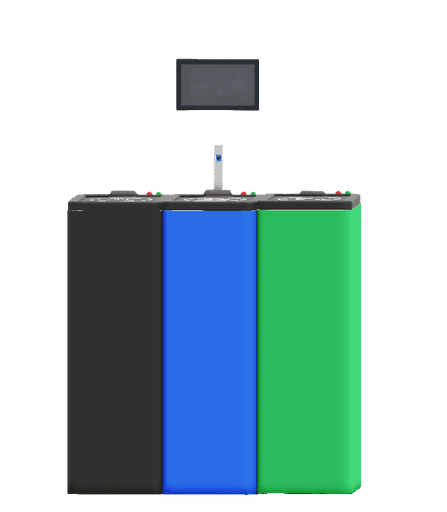
SortAble
Smart AI powered bin system
THE SOLUTION
An AI-supported waste-sorting system designed to:
Reduce user error
Lower contamination rates
Integrate seamlessly with existing 3-bin infrastructure.
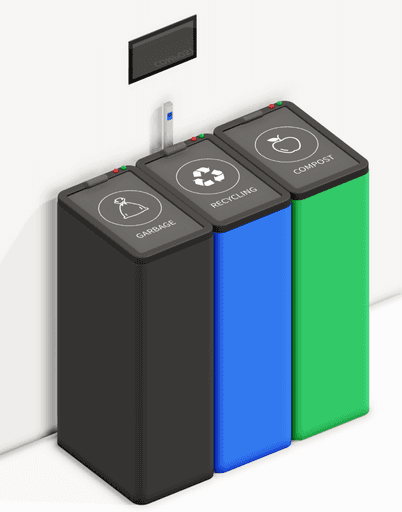
Small Screen Guidance Display
Shows step-by-step guidance
Displays QR code after successful sorting
LED Feedback Lights
Green = Bin unlocked and ready
Red = Do not use
AI Item Detection Camera
AI identifies item type
Detects recycling vs compost vs landfill
Send bin opening signal
Automatic Lid Routing
Opens only when AI approved disposal
Prevents wrong bin usage
Lid closes after item drop
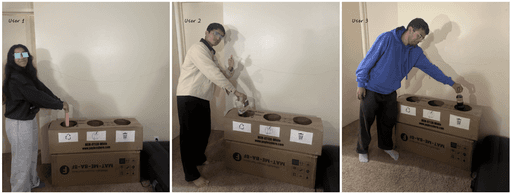
Setting: Home environment
Participants: My flatmates (22-25 years of age)
Process: Over four days, I observed how flatmates interacted with kitchen waste bins, noting hesitation, confusion, confidence, and reliance on others when deciding between biodegradable and non-recyclable bins.
Setting: University of Washington
Participants: Students with ages ranging from 18-30 years old
Process: After each lecture, I observed students at the waste-sorting station, tracking how long they took to identify the correct bin, whether labels and images were helpful, and how their behavior changed when others were watching.
Observations
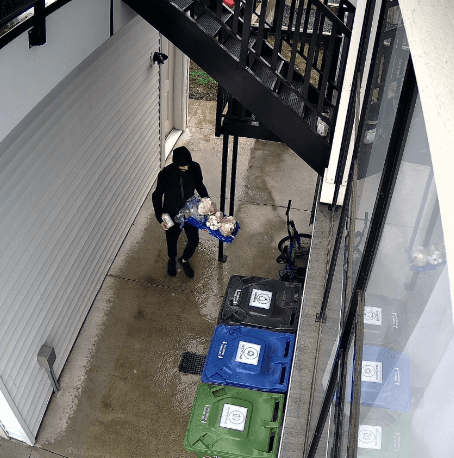
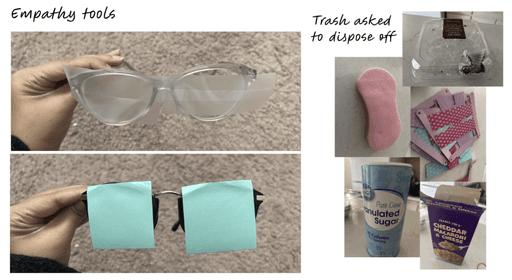
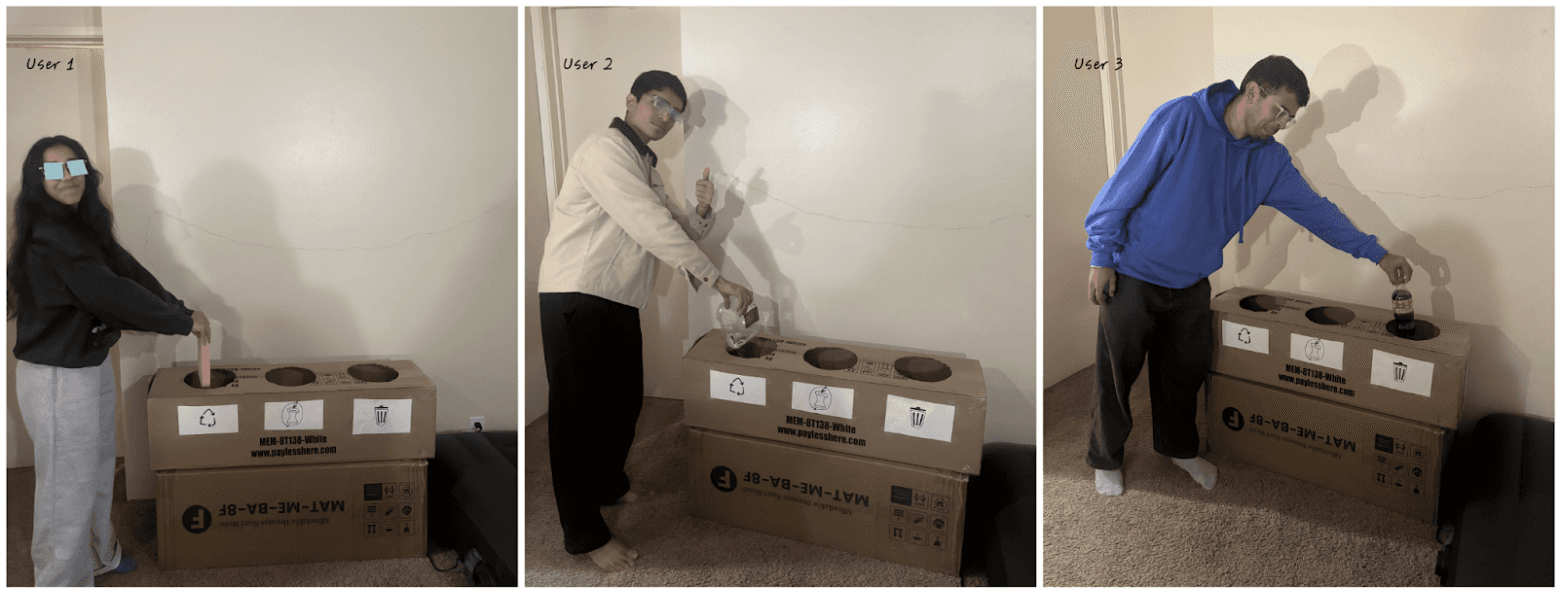
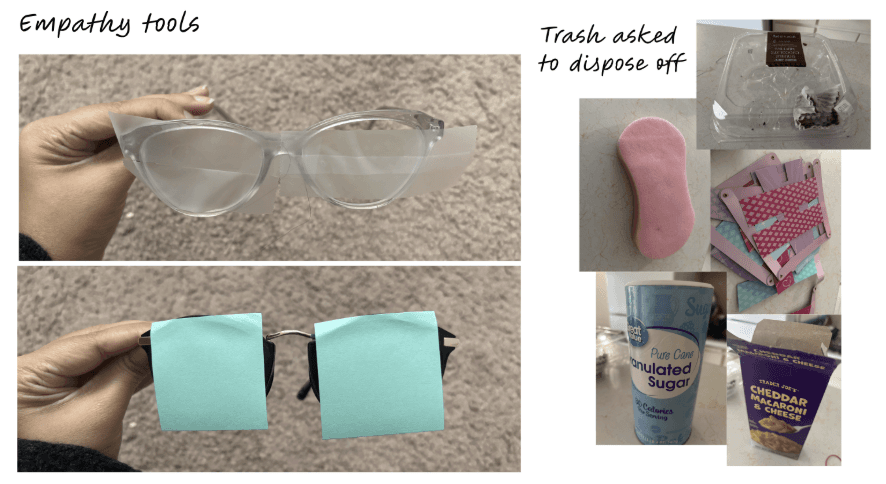
While heavy reliance on visual cues was a problem, for eg, when users couldn’t see clearly, they relied on spatial memory, highlighting the need for consistency while designing public waste bins. Users also mentioned that they struggled with complex packaging, which required time and effort to sort and dispose of accurately. They often prioritized speed and efficiency over accuracy.
Experience prototyping and Empathy tools
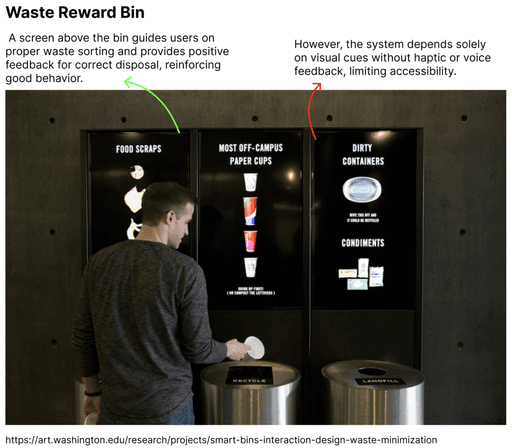
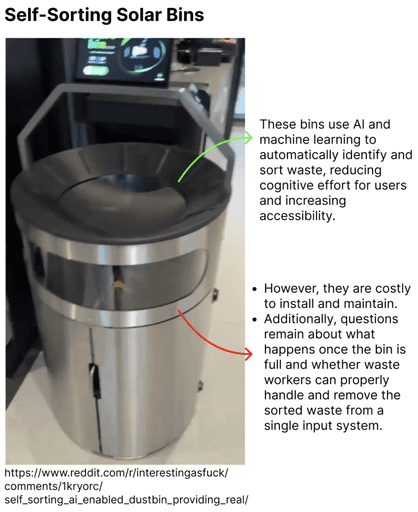
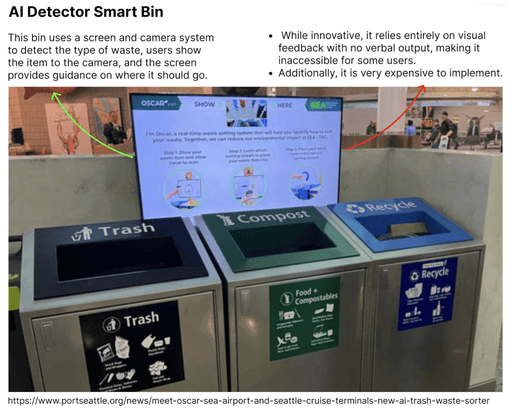
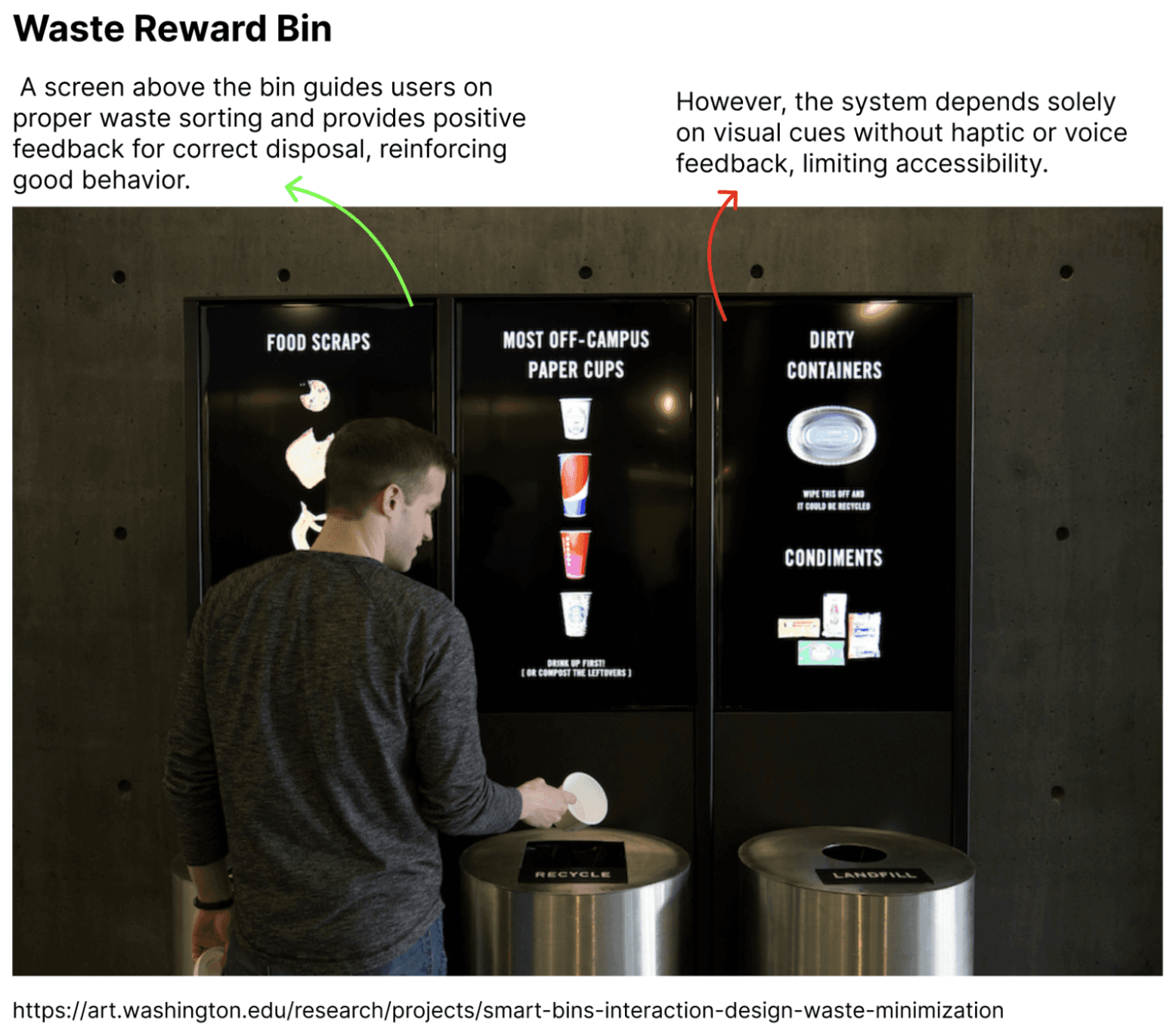
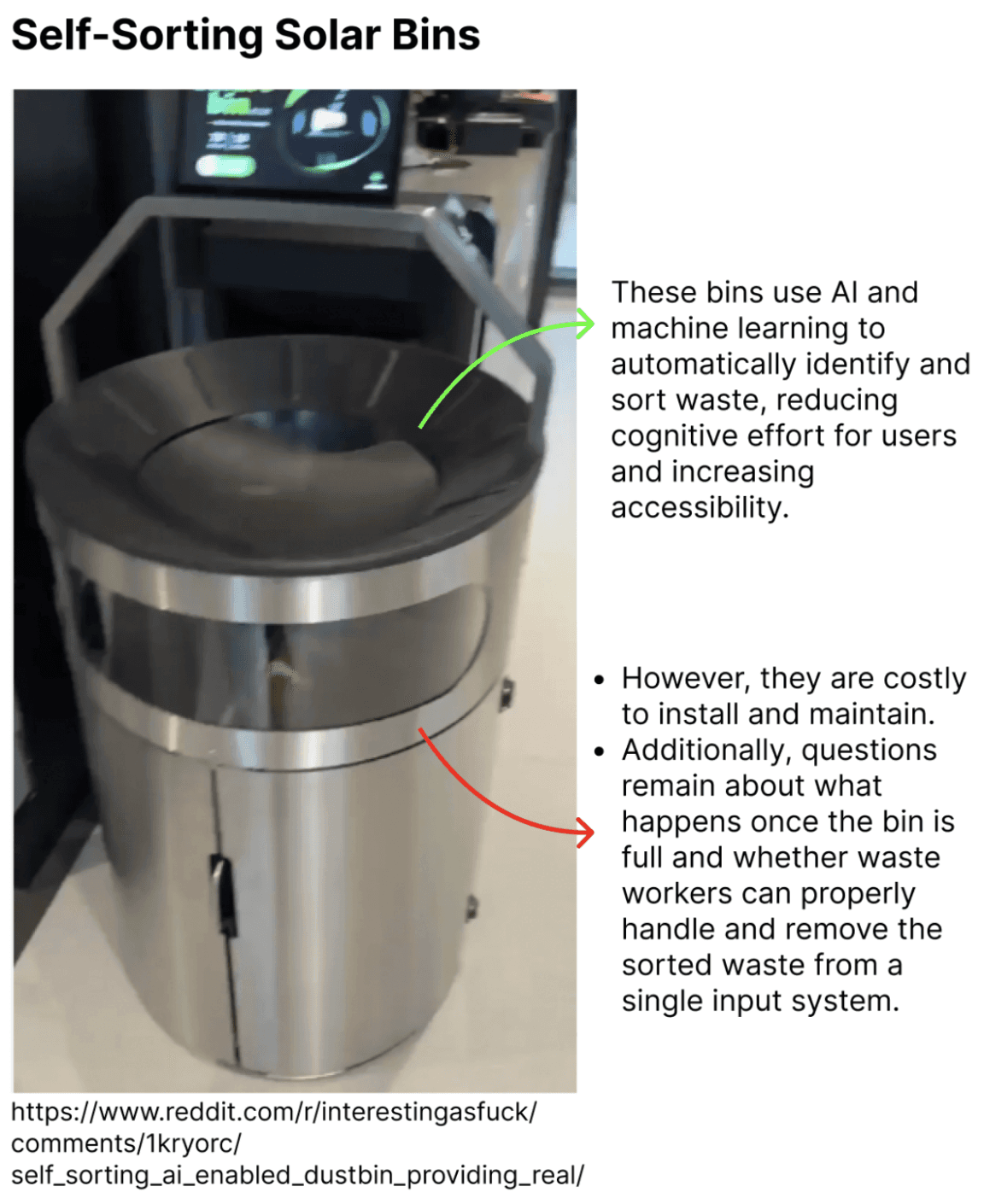
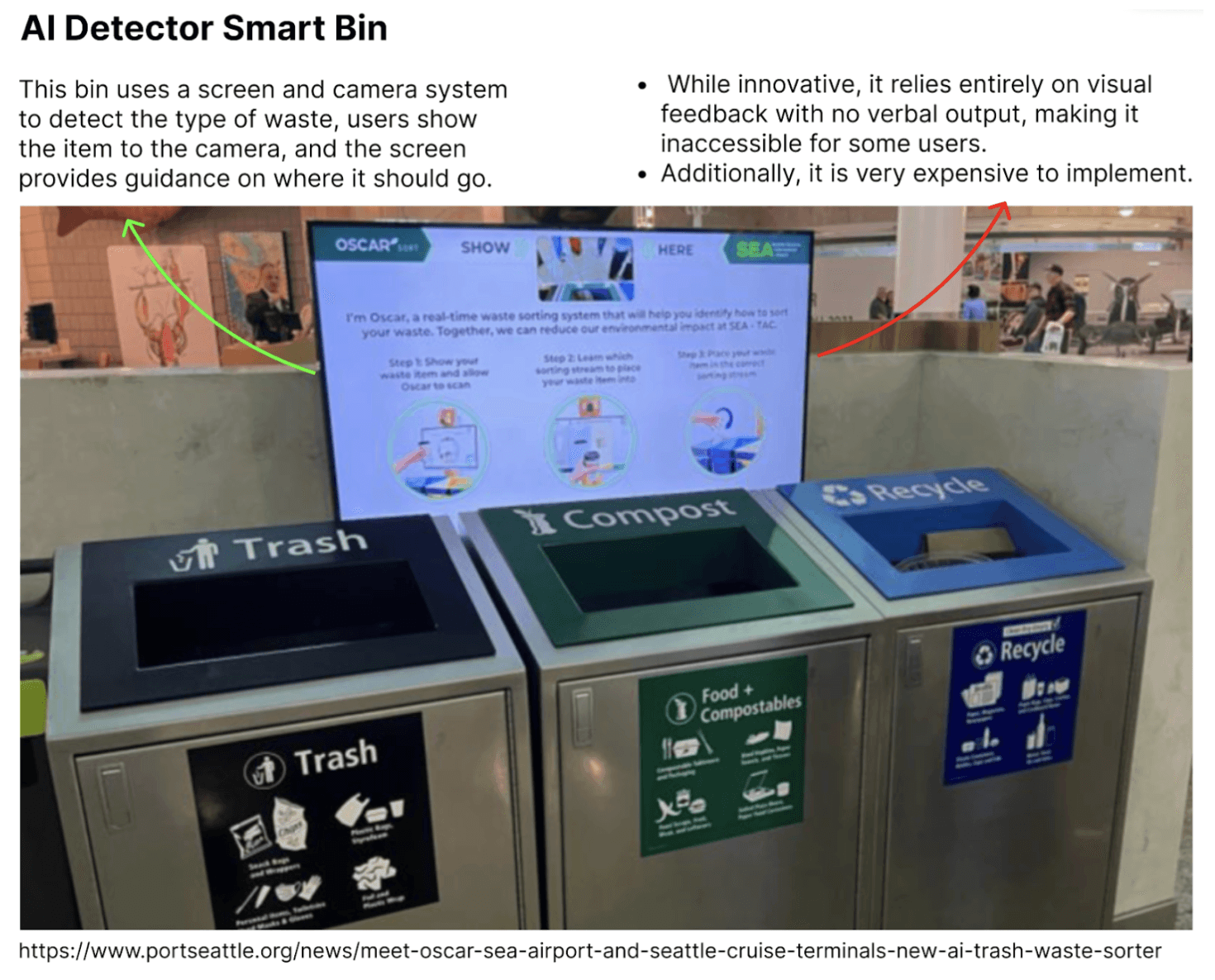
Competitive Product Survey
RESEARCH

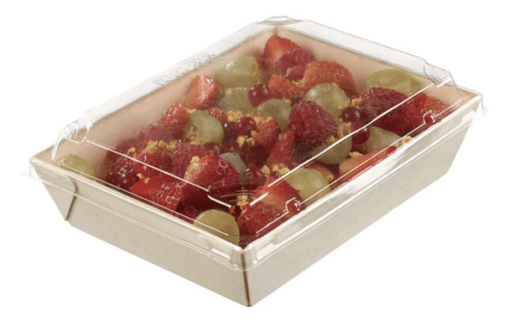
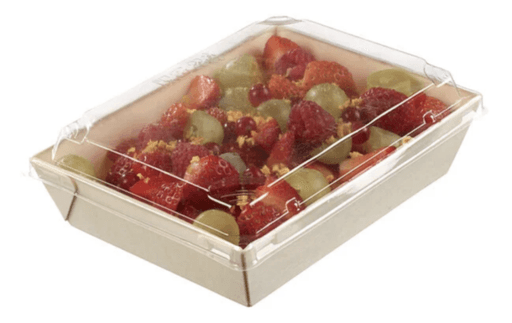
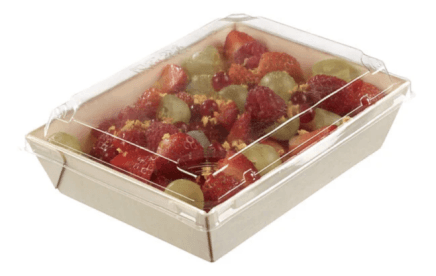
“How would you dispose of this item”
“What makes it difficult for you to sort waste correctly?”
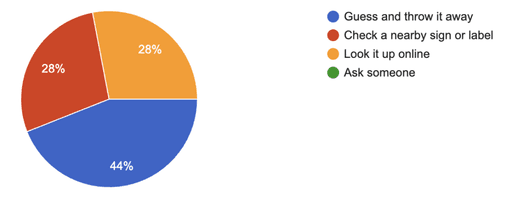
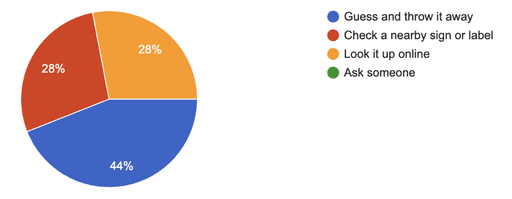
“When unsure where something goes, what do you usually do?”
Contents in compost and container in recycling
Empty the food in the trash and put the plastic in the recycling
Trash bin
Either can be composted or placing in regular bin
Surveys (32 Responses)
Reveal users’ confusion &
lack of confidence
while sorting waste.
Waste systems rely too heavily on visual cues.

Lack of consistency leads to sorting errors.

Social Pressure Drives Proper Sorting.

Cognitive load drives users toward convenience.

Smart bins offer promise but lack practicality.

KEY INSIGHTS
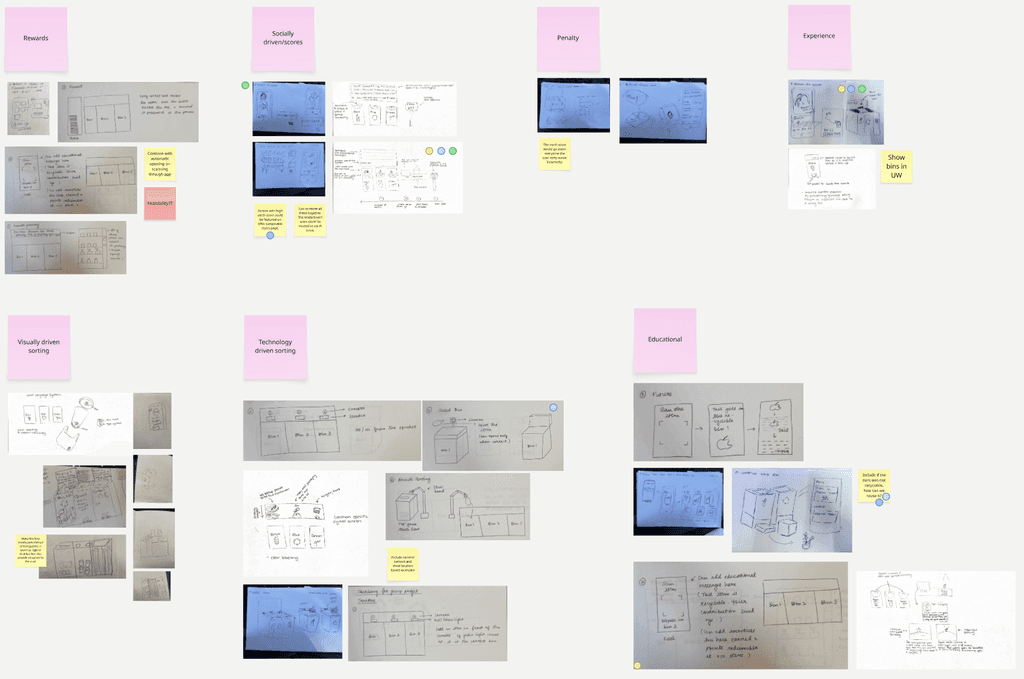
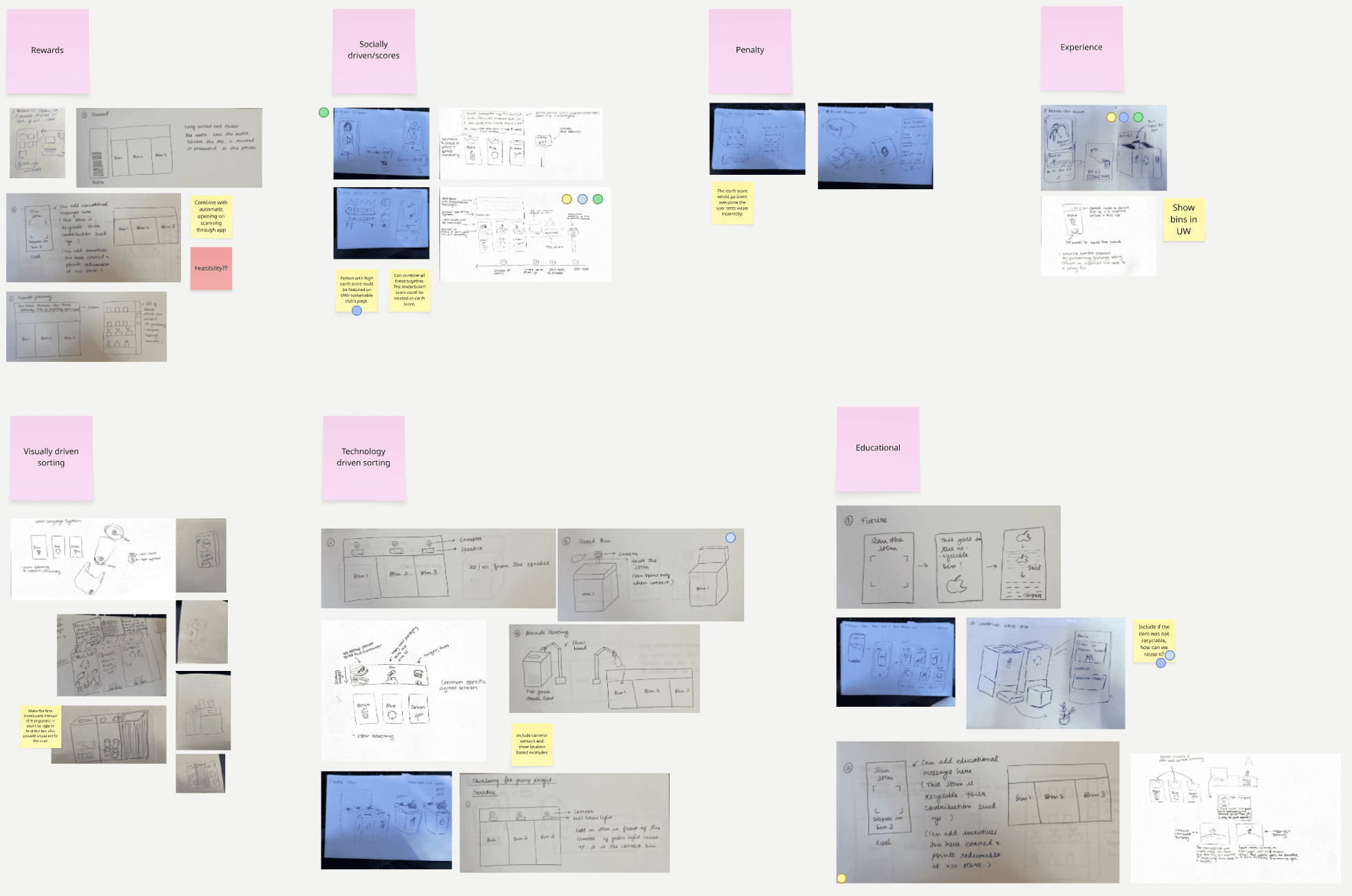
With a clear understanding of user and system needs, we generated a series of sketches to explore different solution directions. We then affinity-clustered these sketches to identify patterns, consolidate ideas, and align on the core themes that would guide the final design.
Each sketch was grounded in the core characteristics of our two personas:
Designing for the student’s need for speed, simplicity, and low cognitive load, and for the worker’s need for accuracy, consistency, and clear guidance.
From Requirements to Concept
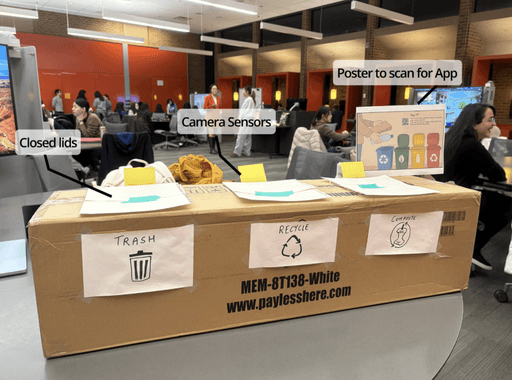
ConductED Usability Testing on the Lo-Fi Prototype
Key elements:
Three compartments (Recycle / Compost / Trash)
Paper lids for Wizard-of-Oz automated lid simulation
Open-lid sections for comparison testing
Sticky-note “camera sensors”
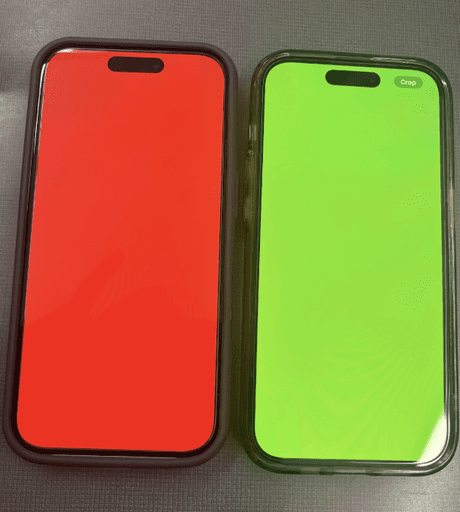
Phone-based red/green light feedback (correct/incorrect bin)
What it tested:
Spatial layout, user hesitation, scanning visibility, and lid interaction behavior.
🗑️ Physical Bin Prototype
Key elements:
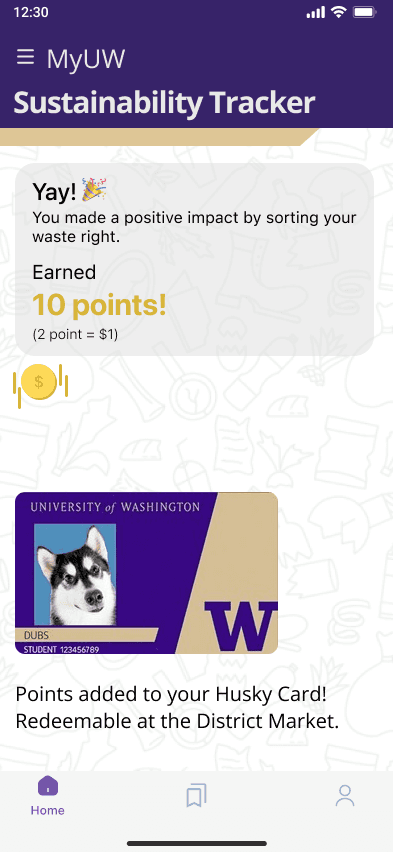
QR code scan confirmation
Points dashboard
Rewards & redemption clarity
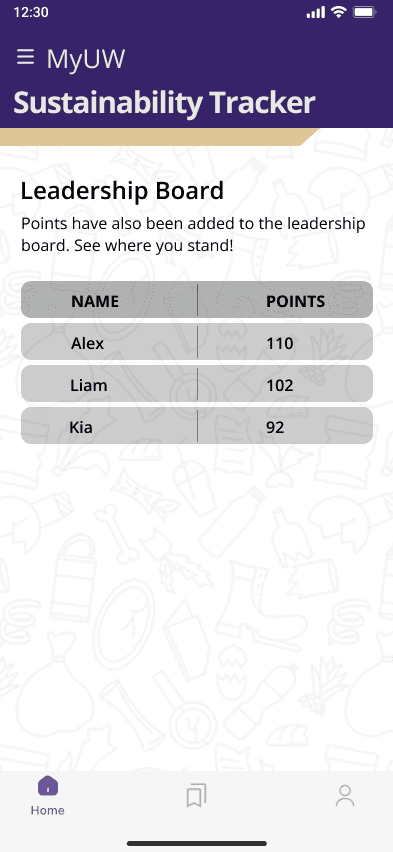
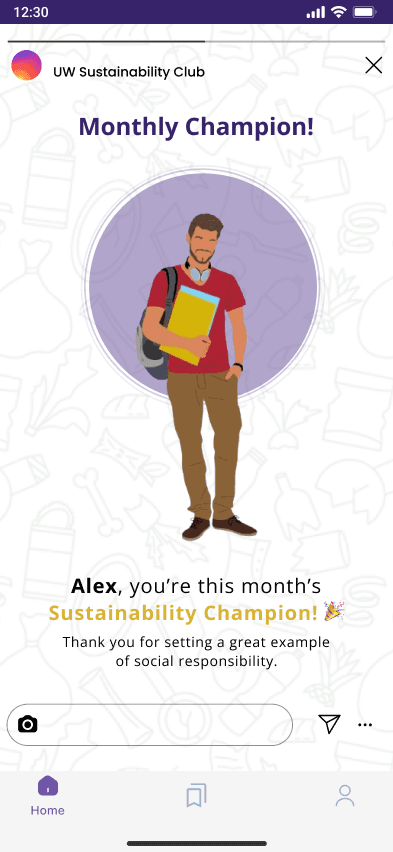
Leaderboard with peer motivation
Seamless app integration (Sustainability section)
What it tested:
Understanding of point value, clarity of redemption flow, and motivation through gamification.
📱 Mid-Fi App Prototype

With the solution user flow defined, we tested early prototypes to validate whether the interactions truly supported our core themes of clarity, engagement, consistency, and confidence.
Closed bins encouraged more intentional sorting.
Open bins led users to ignore the scanner.
Multiple cameras created confusion.
QR code for rewards was missed by most users.
Users didn’t understand the value of their points.
Shifted to closed-bin design.
Removed open bins entirely.
Consolidated cameras into one central scanner.
Added a central instructional screen.
Redesigned Sustainability section in MyUW app.
Key Observations
Design Iterations
FINAL SOLUTION
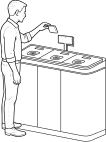
Present Item to Camera
The system automatically identifies the item, eliminating user guesswork and reducing decision friction.
Correct Bin Opens Automatically
By routing items to the correct bin, it significantly decreases mis-sorting and contamination.
Drop Item Into Opened Bin
Reinforces proper sorting patterns.
Scan QR & Earn Points in UW App
Motivates continued sorting by connecting actions to rewards. Leaderboard visibility provides social validation and encourages responsible sorting through gentle social pressure.


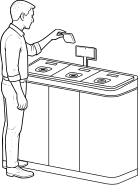
KEY SYSTEM COMPONENTS
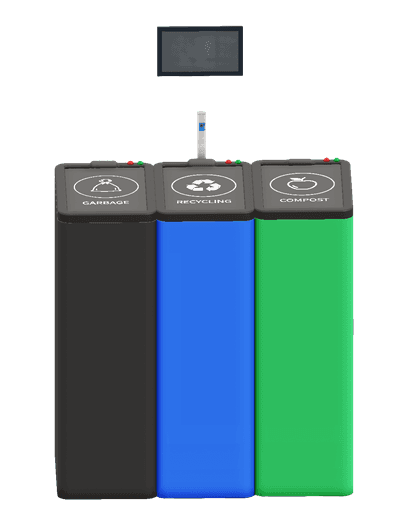
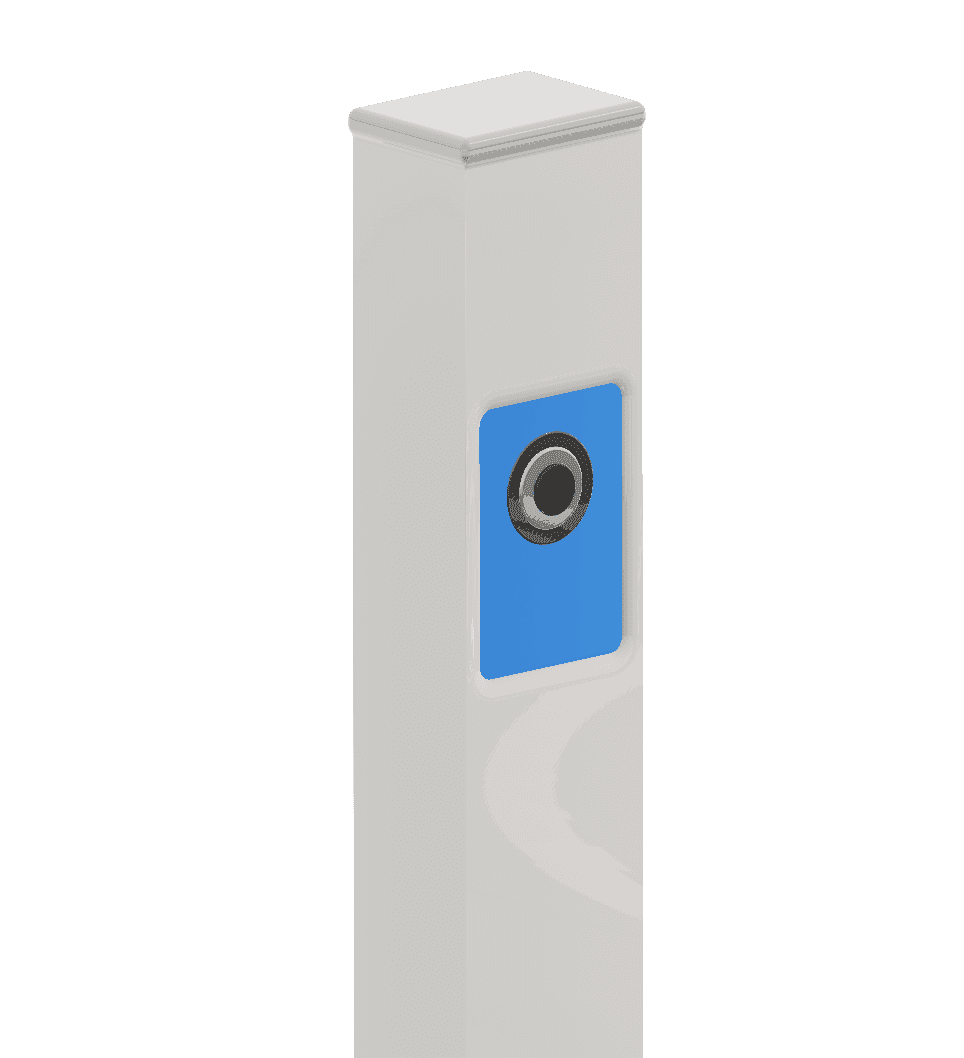
AI Item-Detection Camera
Identifies the item held in front of the lens and classifies it into compost, recycling, or landfill using a campus-trained detection model.
Automatic Bin Routing
Once classified, the correct bin opens automatically via a servo-controlled lid, reducing user effort and eliminating guesswork.
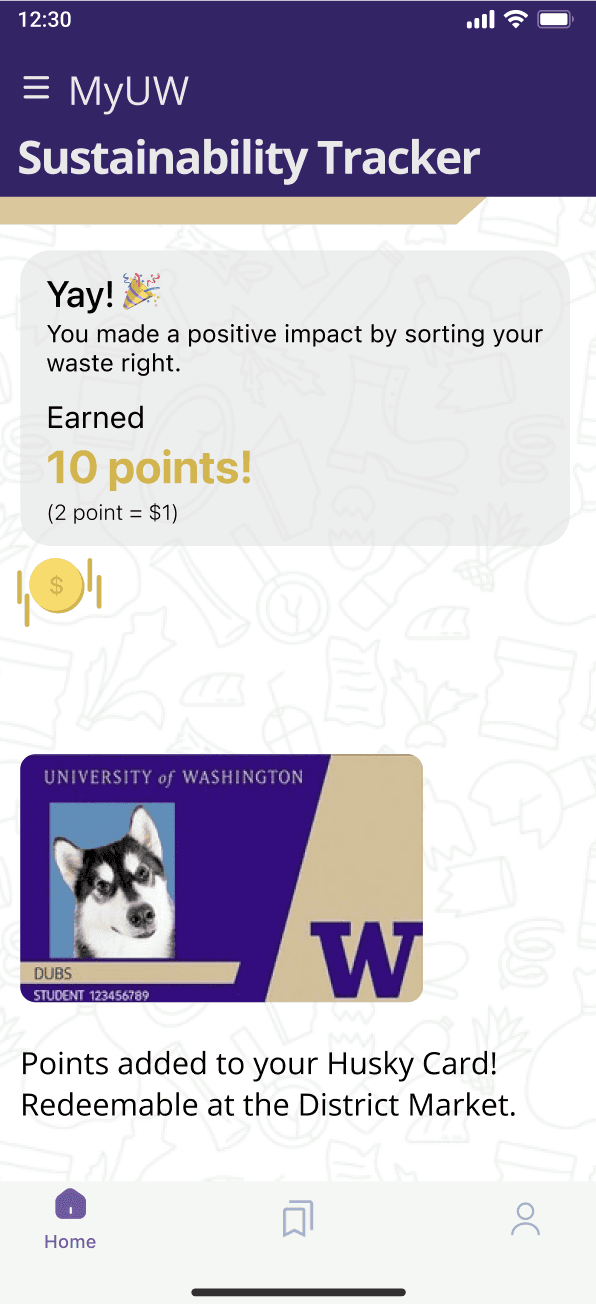
Incentive Integration
(MyUW App)
After disposing, users may scan the QR code to earn sustainability points. Points can be redeemed via their Husky Card, and users can view progress on a leaderboard, encouraging socially reinforced participation.
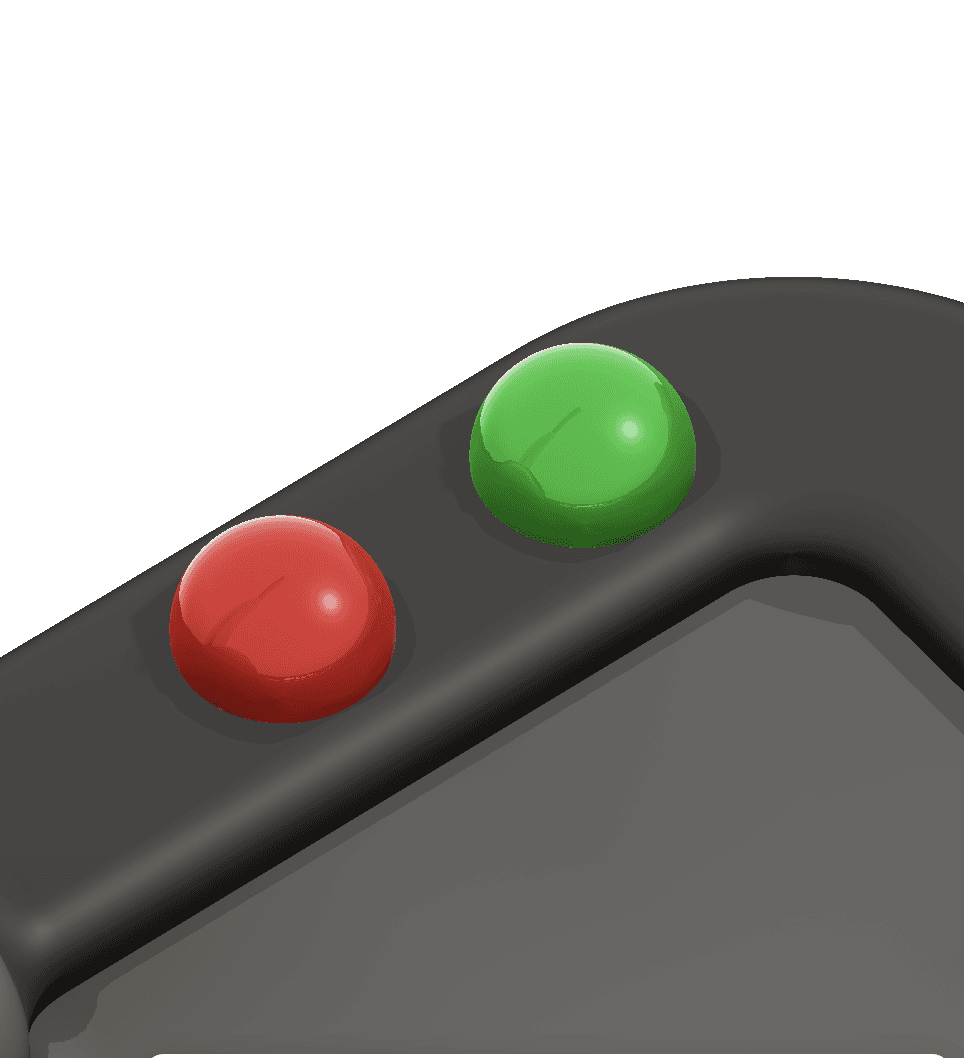
LED Feedback Indicators
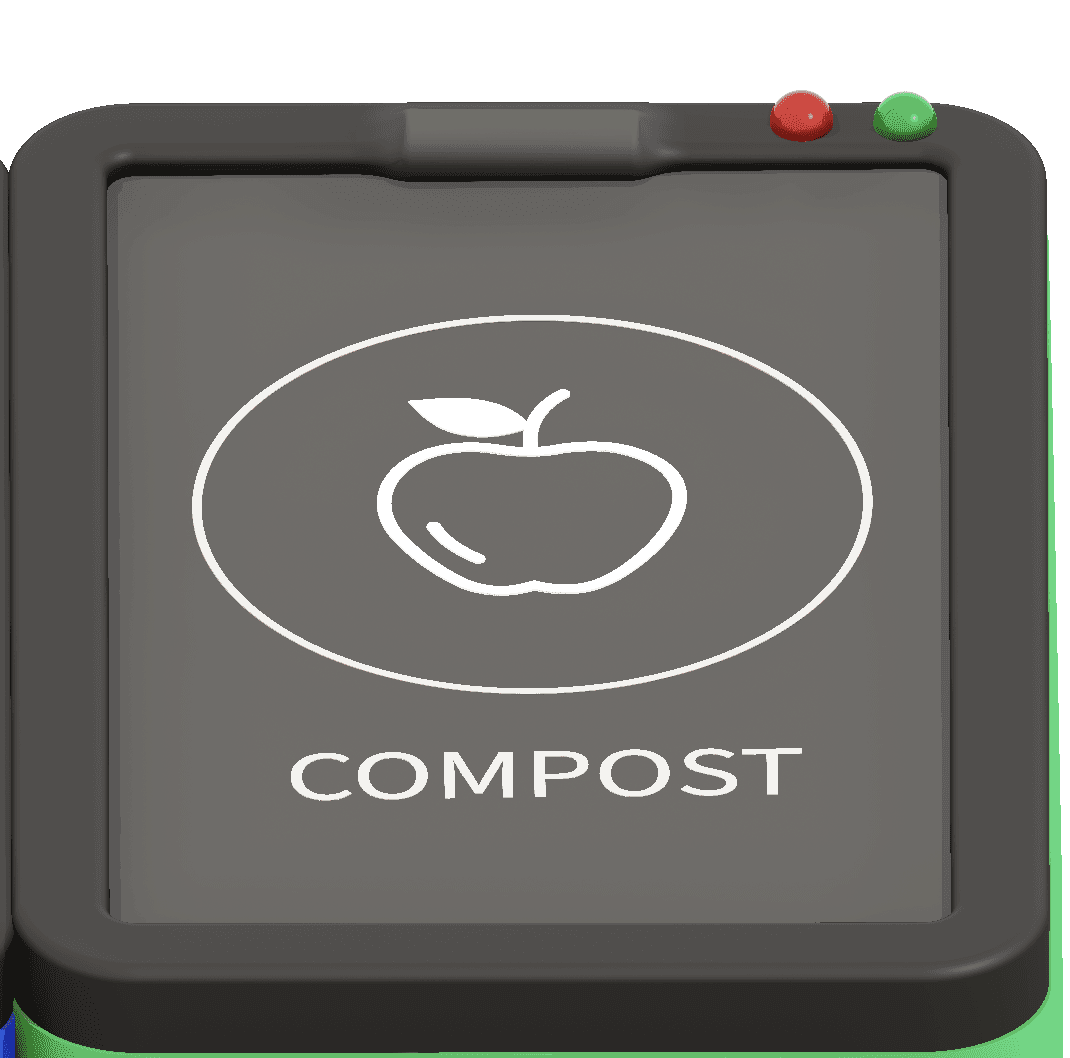
Green confirms correct routing; red appears when classification confidence is low. Low-confidence items default to landfill to protect against cross-stream contamination.
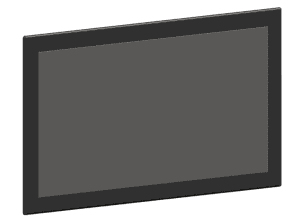
On-Bin Display Interface
Provides quick visual guidance and generates a scannable QR code for user rewards.
LIMITATIONS
While the SortAble concept is feasible, several constraints must be acknowledged:
Implementation Cost:
Building a fully functional smart bin, equipped with sensors, a display screen, and onboard AI hardware, would require an upfront investment. For comparison, existing commercial smart-waste units from competitors such as Bigbelly retail in the ~$1.6k–$4.8k range (Bigbelly Products).
However, long-term cost savings can offset this investment. Seattle Public Utilities (SPU) currently charges $234.80 per ton for commercial garbage disposal, and the city generates approximately 1,300 tons of waste per day. Even modest reductions in landfill-bound waste or contamination can translate into meaningful financial savings at this scale. By improving sorting accuracy and increasing diversion, a smart-bin system has the potential to reduce ongoing disposal costs and provide net savings over time. (Seattle Public Utilities)
Electrical Infrastructure:
Public bins across campus would require access to reliable power sources, which may not be available in all locations.
UW Point System Constraints:
Integrating SortAble with the Husky Card rewards system involves monetary value and would require administrative approval, policy adjustments, and system integration work.
Concurrent Users:
The current design supports one user at a time. Multiple users approaching the system simultaneously could cause confusion or slow down the interaction.
Spending time on SortAble showed me how small design choices can create real confusion in everyday tasks. Turning moments of hesitation and frustration into sketches, flows, and prototypes was challenging but incredibly rewarding. This experience taught me how to design solutions that truly support sustainable habits.
REFLECTION
key user flow
system logic flow
Model Classification Flow
Rewards flow


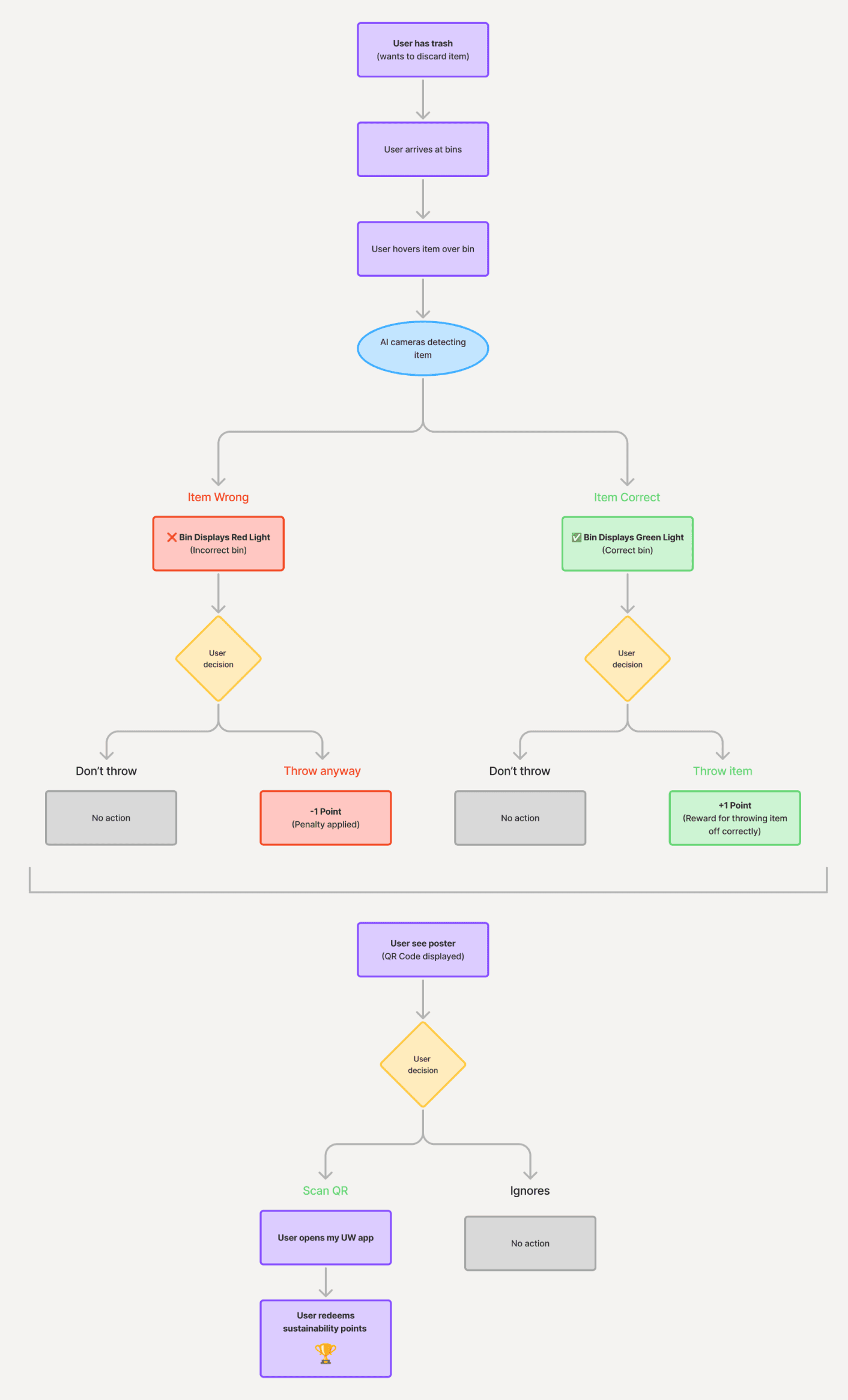
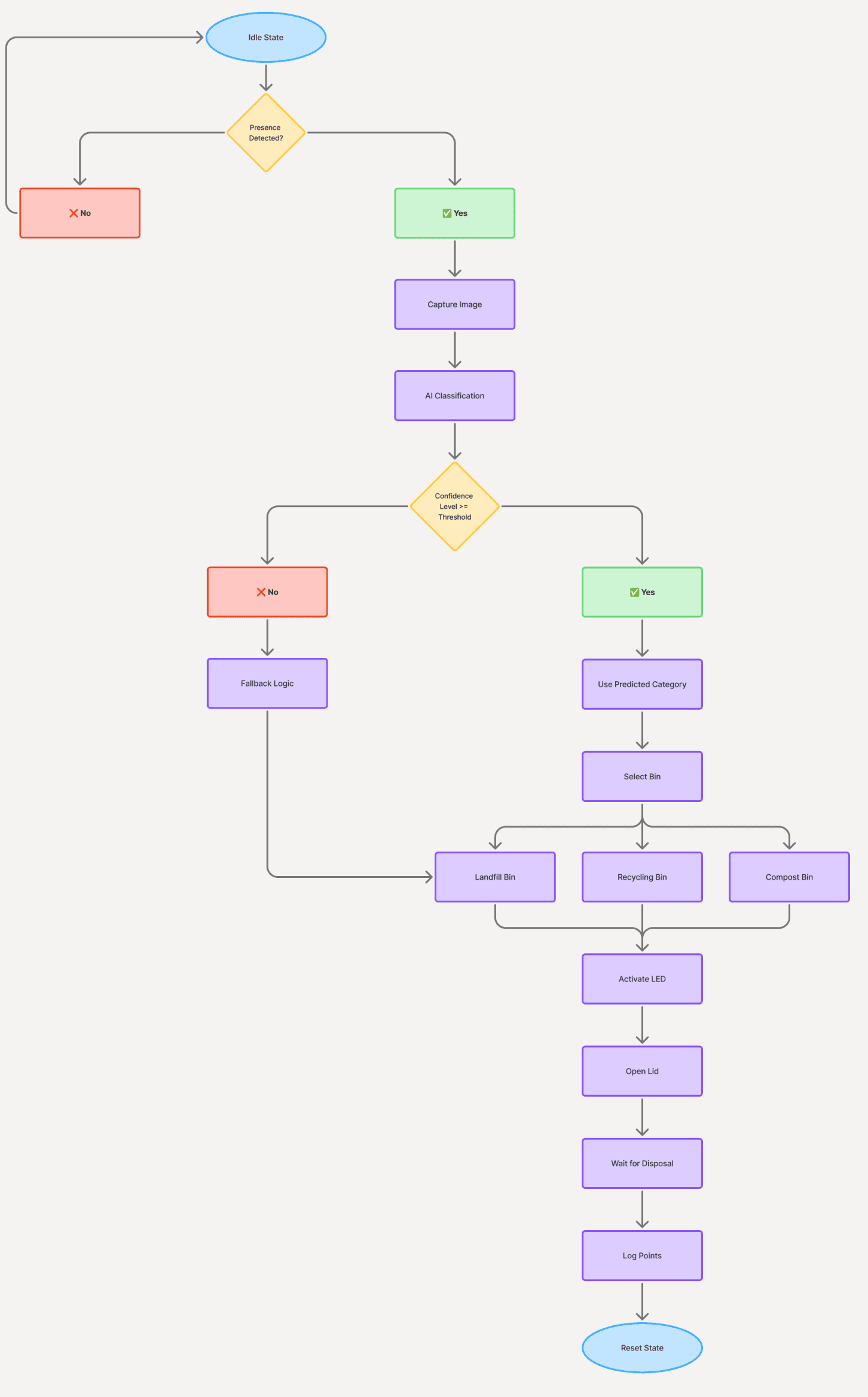
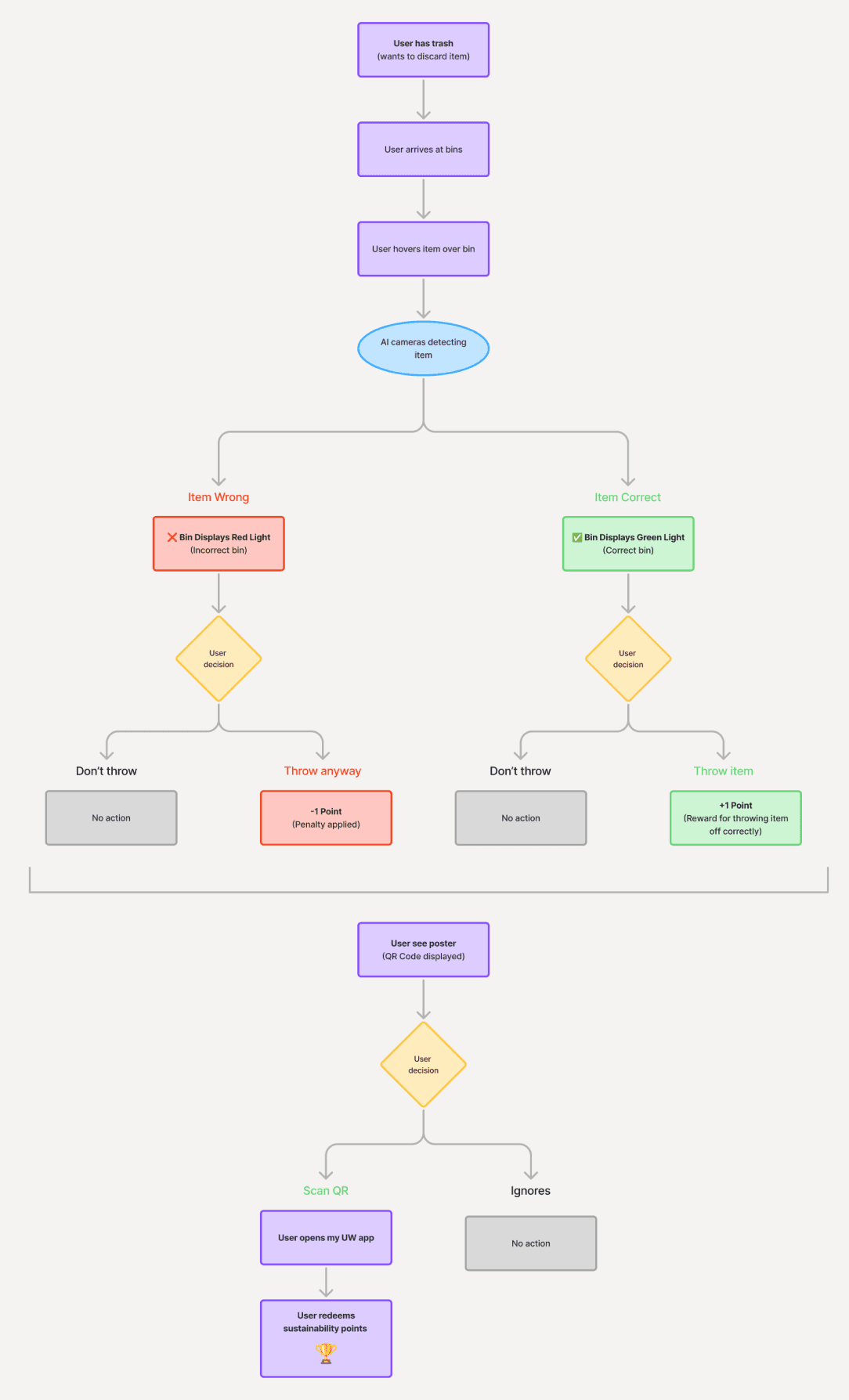
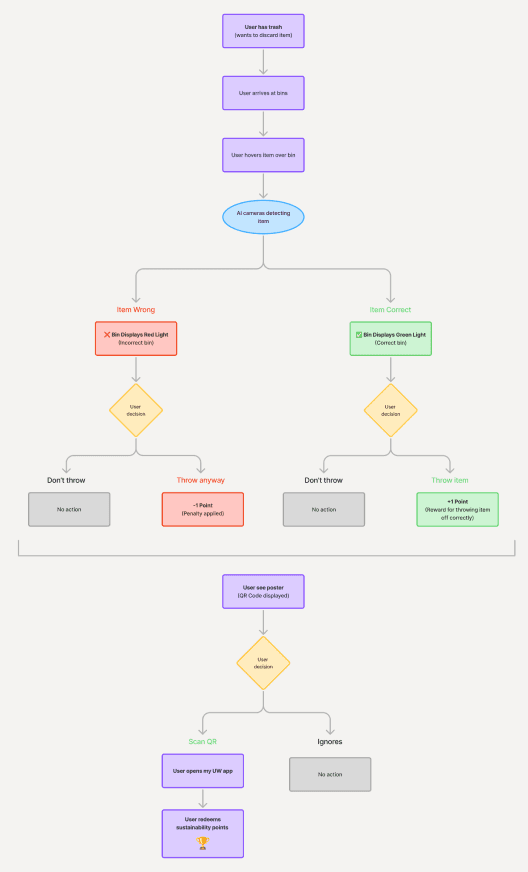
Established the key user flows:
After sketching early concepts, we used our core solution themes and observed behavior of the user to decide which ideas best solved real user problems. These themes helped us refine the sketches into a focused solution and map a clear user flow that showed how the final system should work end-to-end. This flow became the blueprint for our low-fi prototype, defining exactly how users move through the experience and how the system responds at each step.
We derived two key User Personas:
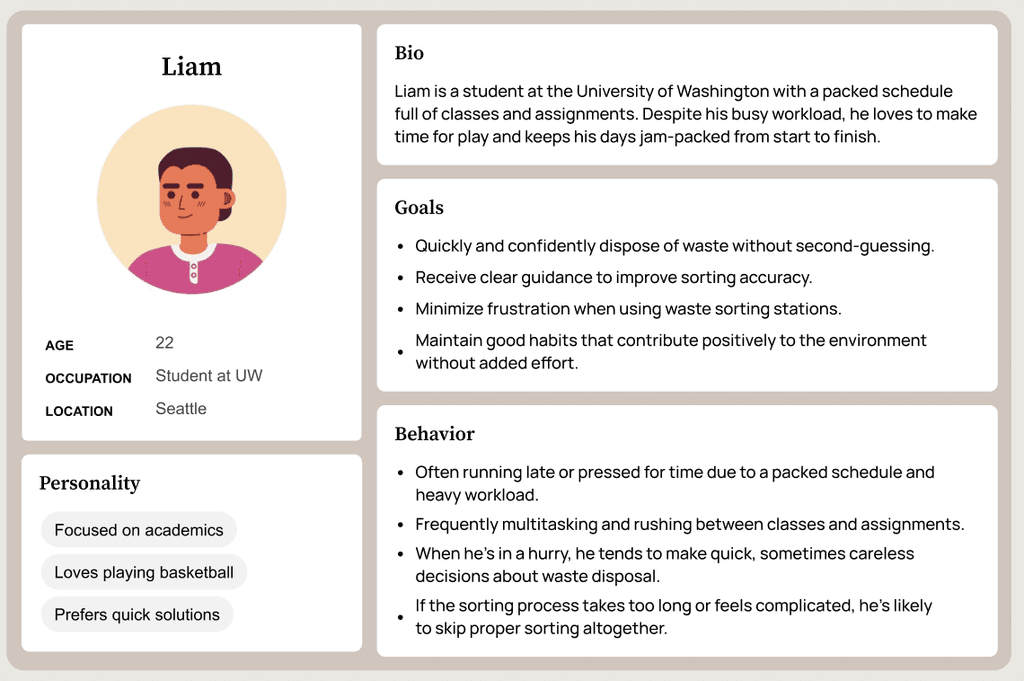
Busy College Student
This persona reflects students observed on campus who sort waste quickly under time pressure, often prioritizing speed over accuracy. Ethnographic notes highlighted strong social influence, that is, students sorted better when others were watching. Their primary needs are clarity, low effort, and motivational rewards.
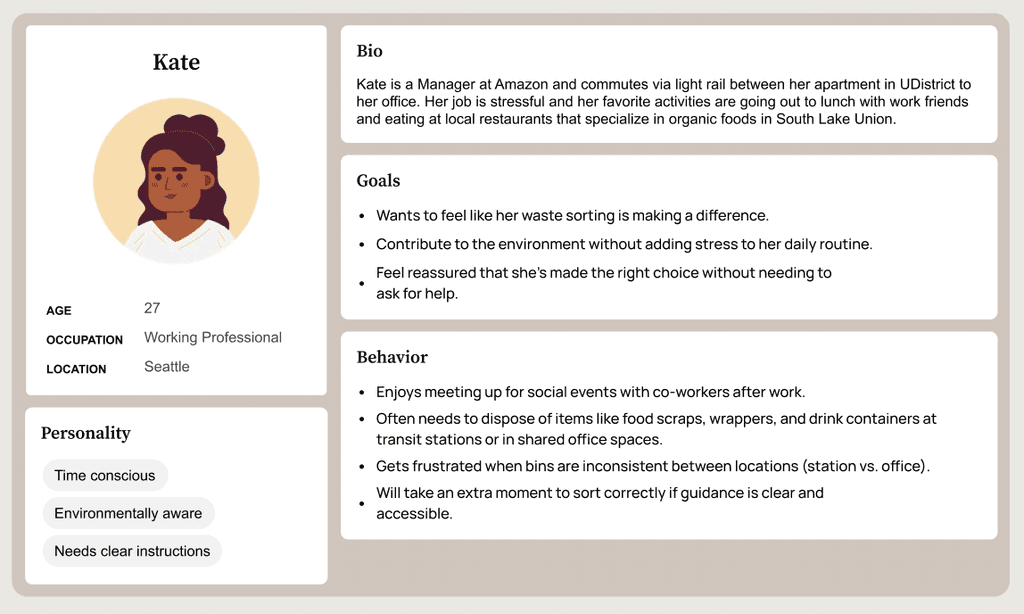
Environmentally Aware Worker
This persona comes from home observations and survey responses showing users who care about sustainability but struggle with inconsistent labels, complex packaging, and systems that rely heavily on visuals. They value accuracy and want reliable, trustworthy guidance, not gamification. Their key needs are consistency, confidence, and clear system feedback.
Usability testing with developers showed that the redesigned workflow was significantly more intuitive and required fewer navigation steps. Participants completed the fix submission process 80% faster than before, with noticeably fewer errors and reduced cognitive effort.
From Frustration to Flow
Simplifying Fix Submissions
80% faster
Completion rate
IMPACT
Product Designer + Developer (me)
Development Team
Management and Leadership Team
TEAM
5-6 months
TIMELINE
WORKFLOW BEFORE
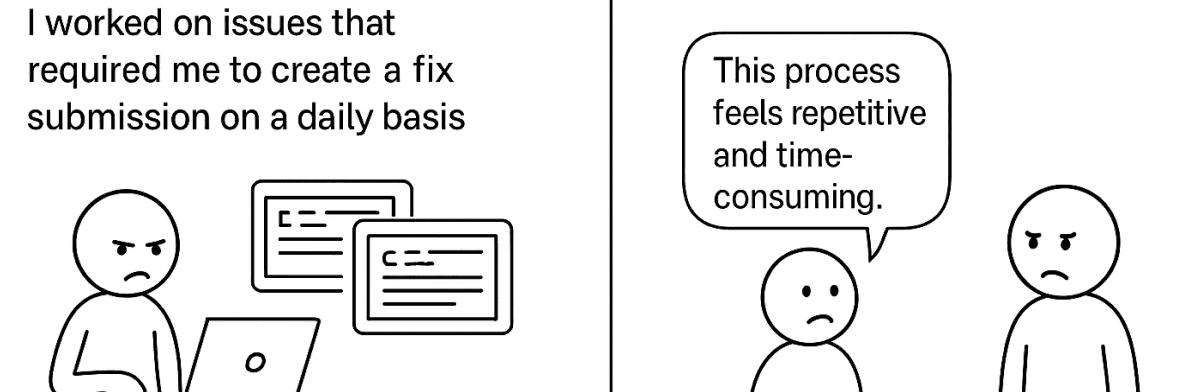
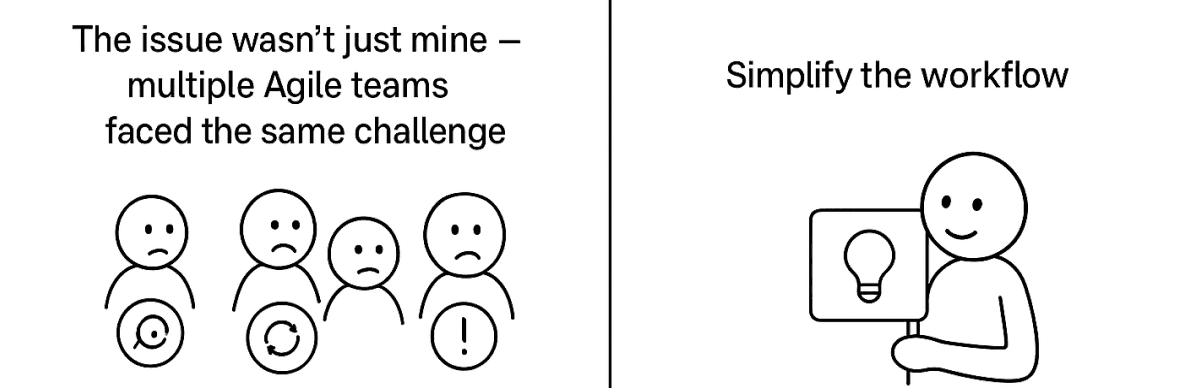
Fragmented and Redundant Workflow
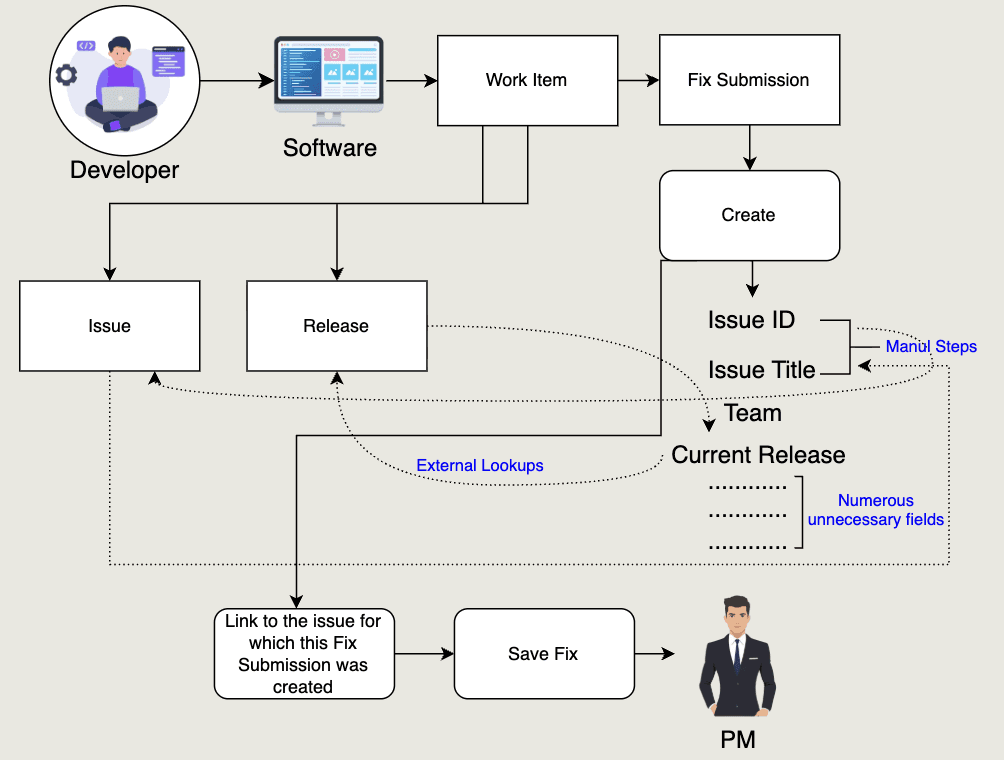
PROBLEM OBSERVED
1
2
3
4
IMPACT ON USERS


Increased task completion time
Repeat the same manual steps multiple times a day
GOAL
Simplify and streamline complex workflows to reduce fix submission creation time for developers.
RESEARCH AND DISCOVERY
DEVELOPERS
Conducted contextual inquiries with developers to understand their existing workflows and pain points in issue tracking and fix submission requests.
Mapped current developer workflows to identify redundant steps and bottlenecks in the issue-resolution process.
SCRUM MASTERS
Facilitated discovery sessions with Scrum Masters to consolidate workflow requirements.
Together, these insights highlighted key opportunities to simplify the process, improve visibility between teams, and align the workflow with real user needs and team structures.
KEY INSIGHTS
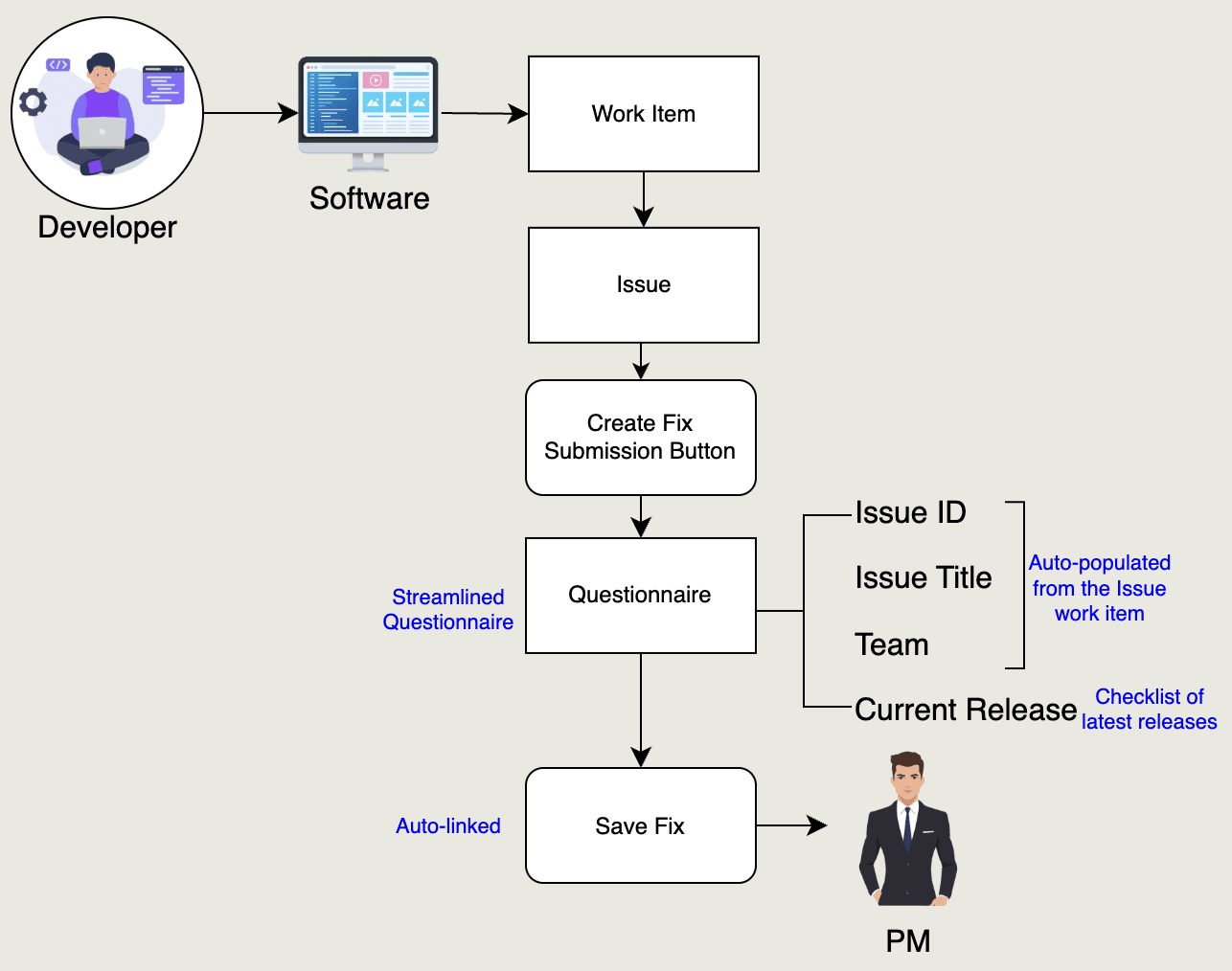
The interface presented too many fields at once, forcing users to spend extra time figuring out which data was relevant to their task.
Cognitive Overload from Visual Clutter
Each team required slightly different information when submitting a fix, leading to confusion, rework, and inconsistent entries across submissions.
Inconsistent Data Requirements Across Teams
After creating a fix submission request, users had to manually associate it with the corresponding issue, an extra step that added friction and delayed completion.
Manual Linking Between Issues and Fix Submission Requests
Users often had to leave the current workflow to look up the most recent release details before submitting a request, interrupting focus and adding unnecessary time.
Lack of visibility into the latest release version for Fix Submission
WORKFLOW AFTER
Streamlined, Contextual, and Automated
VALIDATION
CONFIDENTIALITY DISCLAIMER
Due to NDA restrictions, visuals and content have been recreated and anonymized to protect proprietary information.
IMPACT
Automated classification reduces human error and contamination.
Improved Sorting Accuracy
Decision time decreases from an average of 3–6 seconds to as little as 1–2 seconds.
Reduced
Cognitive Load
Works with existing 3-bin setups for easy deployment.
Scalable for Public Environments
Rewards and social visibility encourage ongoing use, not just one-time compliance.
Higher Engagement & Long-Term Adoption
IMPACT
Automated classification reduces human error and contamination.
Improved Sorting Accuracy
Decision time decreases from an average of 3–6 seconds to as little as 1–2 seconds.
Reduced
Cognitive Load
Works with existing 3-bin setups for easy deployment.
Scalable for Public Environments
Rewards and social visibility encourage ongoing use, not just one-time compliance.
Higher Engagement & Long-Term Adoption
IMPACT
Automated classification reduces human error and contamination.
Improved Sorting Accuracy
Decision time decreases from an average of 3–6 seconds to as little as 1–2 seconds.
Reduced
Cognitive Load
Works with existing 3-bin setups for easy deployment.
Scalable for Public Environments
Rewards and social visibility encourage ongoing use, not just one-time compliance.
Higher Engagement & Long-Term Adoption
IMPACT
Automated classification reduces human error and contamination.
Improved Sorting Accuracy
Decision time decreases from an average of 3–6 seconds to as little as 1–2 seconds.
Reduced
Cognitive Load
Works with existing 3-bin setups for easy deployment.
Scalable for Public Environments
Rewards and social visibility encourage ongoing use, not just one-time compliance.
Higher Engagement & Long-Term Adoption
These insights informed four key design requirements for the system:
The design should make proper waste sorting easy to reduce user hesitation at the bin.
Ease & Clarity
The design should motivate users to sort correctly.
Engagement
The system should ensure that users consistently deposit items in the correct bin.
Consistency
The design should make users feel confident approaching any bin, anywhere on campus.
User Confidence
These insights informed four key design requirements for the system:
The design should make proper waste sorting easy to reduce user hesitation at the bin.
Ease & Clarity
The design should motivate users to sort correctly.
Engagement
The system should ensure that users consistently deposit items in the correct bin.
Consistency
The design should make users feel confident approaching any bin, anywhere on campus.
User Confidence
These insights informed four key design requirements for the system:
The design should make proper waste sorting easy to reduce user hesitation at the bin.
Ease & Clarity
The design should motivate users to sort correctly.
Engagement
The system should ensure that users consistently deposit items in the correct bin.
Consistency
The design should make users feel confident approaching any bin, anywhere on campus.
User Confidence
We loose nearly over a third of its potentially recoverable waste not because it’s unrecyclable, but because it’s SORTED WRONG.
According to data from The Atlanta Journal
38% of recyclables rejected due to contamination
We loose nearly over a third of its potentially recoverable waste not because it’s unrecyclable, but because it’s SORTED WRONG.
According to data from The Atlanta Journal
38% of recyclables rejected due to contamination
We loose nearly over a third of its potentially recoverable waste not because it’s unrecyclable, but because it’s SORTED WRONG.
According to data from The Atlanta Journal
38% of recyclables rejected due to contamination
How might we design waste-sorting solutions that induce behavioral change for accurate and responsible waste disposal by leveraging social pressure and incentives?
How might we design waste-sorting solutions that induce behavioral change for accurate and responsible waste disposal by leveraging social pressure and incentives?
How might we design waste-sorting solutions that induce behavioral change for accurate and responsible waste disposal by leveraging social pressure and incentives?
SortAble
Smart AI powered bin system
SortAble
Smart AI powered bin system
SortAble
Smart AI powered bin system
THE SOLUTION
An AI-supported waste-sorting system designed to:
Reduce user error
Lower contamination rates
Integrate seamlessly with existing 3-bin infrastructure.
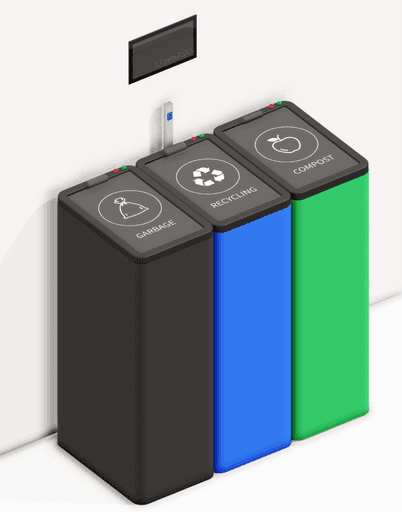
Small Screen Guidance Display
Shows step-by-step guidance
Displays QR code after successful sorting
LED Feedback Lights
Green = Bin unlocked and ready
Red = Do not use
AI Item Detection Camera
AI identifies item type
Detects recycling vs compost vs landfill
Send bin opening signal
Automatic Lid Routing
Opens only when AI approved disposal
Prevents wrong bin usage
Lid closes after item drop
THE SOLUTION
An AI-supported waste-sorting system designed to:
Reduce user error
Lower contamination rates
Integrate seamlessly with existing 3-bin infrastructure.
Small Screen Guidance Display
Shows step-by-step guidance
Displays QR code after successful sorting
LED Feedback Lights
Green = Bin unlocked and ready
Red = Do not use
AI Item Detection Camera
AI identifies item type
Detects recycling vs compost vs landfill
Send bin opening signal
Automatic Lid Routing
Opens only when AI approved disposal
Prevents wrong bin usage
Lid closes after item drop
THE SOLUTION
An AI-supported waste-sorting system designed to:
Reduce user error
Lower contamination rates
Integrate seamlessly with existing 3-bin infrastructure.
Small Screen Guidance Display
Shows step-by-step guidance
Displays QR code after successful sorting
LED Feedback Lights
Green = Bin unlocked and ready
Red = Do not use
AI Item Detection Camera
AI identifies item type
Detects recycling vs compost vs landfill
Send bin opening signal
Automatic Lid Routing
Opens only when AI approved disposal
Prevents wrong bin usage
Lid closes after item drop
THE SOLUTION
An AI-supported waste-sorting system designed to:
Reduce user error
Lower contamination rates
Integrate seamlessly with existing 3-bin infrastructure.
Small Screen Guidance Display
Shows step-by-step guidance
Displays QR code after successful sorting
LED Feedback Lights
Green = Bin unlocked and ready
Red = Do not use
AI Item Detection Camera
AI identifies item type
Detects recycling vs compost vs landfill
Send bin opening signal
Automatic Lid Routing
Opens only when AI approved disposal
Prevents wrong bin usage
Lid closes after item drop
Setting: Home environment
Participants: My flatmates (22-25 years of age)
Process: Over four days, I observed how flatmates interacted with kitchen waste bins, noting hesitation, confusion, confidence, and reliance on others when deciding between biodegradable and non-recyclable bins.
Setting: University of Washington
Participants: Students with ages ranging from 18-30 years old
Process: After each lecture, I observed students at the waste-sorting station, tracking how long they took to identify the correct bin, whether labels and images were helpful, and how their behavior changed when others were watching.
Observations
While heavy reliance on visual cues was a problem, for eg, when users couldn’t see clearly, they relied on spatial memory, highlighting the need for consistency while designing public waste bins. Users also mentioned that they struggled with complex packaging, which required time and effort to sort and dispose of accurately. They often prioritized speed and efficiency over accuracy.
Experience prototyping and Empathy tools
Competitive Product Survey
Setting: Home environment
Participants: My flatmates (22-25 years of age)
Process: Over four days, I observed how flatmates interacted with kitchen waste bins, noting hesitation, confusion, confidence, and reliance on others when deciding between biodegradable and non-recyclable bins.
Setting: University of Washington
Participants: Students with ages ranging from 18-30 years old
Process: After each lecture, I observed students at the waste-sorting station, tracking how long they took to identify the correct bin, whether labels and images were helpful, and how their behavior changed when others were watching.
Observations
While heavy reliance on visual cues was a problem, for eg, when users couldn’t see clearly, they relied on spatial memory, highlighting the need for consistency while designing public waste bins. Users also mentioned that they struggled with complex packaging, which required time and effort to sort and dispose of accurately. They often prioritized speed and efficiency over accuracy.
Experience prototyping and Empathy tools
Competitive Product Survey
Setting: Home environment
Participants: My flatmates (22-25 years of age)
Process: Over four days, I observed how flatmates interacted with kitchen waste bins, noting hesitation, confusion, confidence, and reliance on others when deciding between biodegradable and non-recyclable bins.
Setting: University of Washington
Participants: Students with ages ranging from 18-30 years old
Process: After each lecture, I observed students at the waste-sorting station, tracking how long they took to identify the correct bin, whether labels and images were helpful, and how their behavior changed when others were watching.
Observations
While heavy reliance on visual cues was a problem, for eg, when users couldn’t see clearly, they relied on spatial memory, highlighting the need for consistency while designing public waste bins. Users also mentioned that they struggled with complex packaging, which required time and effort to sort and dispose of accurately. They often prioritized speed and efficiency over accuracy.
Experience prototyping and Empathy tools
Competitive Product Survey
Setting: Home environment
Participants: My flatmates (22-25 years of age)
Process: Over four days, I observed how flatmates interacted with kitchen waste bins, noting hesitation, confusion, confidence, and reliance on others when deciding between biodegradable and non-recyclable bins.
Setting: University of Washington
Participants: Students with ages ranging from 18-30 years old
Process: After each lecture, I observed students at the waste-sorting station, tracking how long they took to identify the correct bin, whether labels and images were helpful, and how their behavior changed when others were watching.
Observations
While heavy reliance on visual cues was a problem, for eg, when users couldn’t see clearly, they relied on spatial memory, highlighting the need for consistency while designing public waste bins. Users also mentioned that they struggled with complex packaging, which required time and effort to sort and dispose of accurately. They often prioritized speed and efficiency over accuracy.
Experience prototyping and Empathy tools
Competitive Product Survey
RESEARCH
RESEARCH
RESEARCH
“How would you dispose of this item”
“What makes it difficult for you to sort waste correctly?”
“When unsure where something goes, what do you usually do?”
Contents in compost and container in recycling
Empty the food in the trash and put the plastic in the recycling
Trash bin
Either can be composted or placing in regular bin
Surveys (32 Responses)
Reveal users’ confusion &
lack of confidence
while sorting waste.
“How would you dispose of this item”
“What makes it difficult for you to sort waste correctly?”
“When unsure where something goes, what do you usually do?”
Contents in compost and container in recycling
Empty the food in the trash and put the plastic in the recycling
Trash bin
Either can be composted or placing in regular bin
Surveys (32 Responses)
Reveal users’ confusion &
lack of confidence
while sorting waste.
“How would you dispose of this item”
“What makes it difficult for you to sort waste correctly?”
“When unsure where something goes, what do you usually do?”
Contents in compost and container in recycling
Empty the food in the trash and put the plastic in the recycling
Trash bin
Either can be composted or placing in regular bin
Surveys (32 Responses)
Reveal users’ confusion &
lack of confidence
while sorting waste.
“How would you dispose of this item”
“What makes it difficult for you to sort waste correctly?”
“When unsure where something goes, what do you usually do?”
Contents in compost and container in recycling
Empty the food in the trash and put the plastic in the recycling
Trash bin
Either can be composted or placing in regular bin
Surveys (32 Responses)
Reveal users’ confusion &
lack of confidence
while sorting waste.
Waste systems rely too heavily on visual cues.
Lack of consistency leads to sorting errors.

Social Pressure Drives Proper Sorting.
Cognitive load drives users toward convenience.
Smart bins offer promise but lack practicality.
KEY INSIGHTS
Waste systems rely too heavily on visual cues.
Lack of consistency leads to sorting errors.
Social Pressure Drives Proper Sorting.
Cognitive load drives users toward convenience.
Smart bins offer promise but lack practicality.
KEY INSIGHTS
Waste systems rely too heavily on visual cues.
Lack of consistency leads to sorting errors.
Social Pressure Drives Proper Sorting.
Cognitive load drives users toward convenience.
Smart bins offer promise but lack practicality.
KEY INSIGHTS
Waste systems rely too heavily on visual cues.
Lack of consistency leads to sorting errors.
Social Pressure Drives Proper Sorting.
Cognitive load drives users toward convenience.
Smart bins offer promise but lack practicality.
KEY INSIGHTS
With a clear understanding of user and system needs, we generated a series of sketches to explore different solution directions. We then affinity-clustered these sketches to identify patterns, consolidate ideas, and align on the core themes that would guide the final design.
Each sketch was grounded in the core characteristics of our two personas:
Designing for the student’s need for speed, simplicity, and low cognitive load, and for the worker’s need for accuracy, consistency, and clear guidance.
From Requirements to Concept
With a clear understanding of user and system needs, we generated a series of sketches to explore different solution directions. We then affinity-clustered these sketches to identify patterns, consolidate ideas, and align on the core themes that would guide the final design.
Each sketch was grounded in the core characteristics of our two personas:
Designing for the student’s need for speed, simplicity, and low cognitive load, and for the worker’s need for accuracy, consistency, and clear guidance.
From Requirements to Concept
With a clear understanding of user and system needs, we generated a series of sketches to explore different solution directions. We then affinity-clustered these sketches to identify patterns, consolidate ideas, and align on the core themes that would guide the final design.
Each sketch was grounded in the core characteristics of our two personas:
Designing for the student’s need for speed, simplicity, and low cognitive load, and for the worker’s need for accuracy, consistency, and clear guidance.
From Requirements to Concept
With a clear understanding of user and system needs, we generated a series of sketches to explore different solution directions. We then affinity-clustered these sketches to identify patterns, consolidate ideas, and align on the core themes that would guide the final design.
Each sketch was grounded in the core characteristics of our two personas:
Designing for the student’s need for speed, simplicity, and low cognitive load, and for the worker’s need for accuracy, consistency, and clear guidance.
From Requirements to Concept
ConductED Usability Testing on the Lo-Fi Prototype
Key elements:
Three compartments (Recycle / Compost / Trash)
Paper lids for Wizard-of-Oz automated lid simulation
Open-lid sections for comparison testing
Sticky-note “camera sensors”
Phone-based red/green light feedback (correct/incorrect bin)
What it tested:
Spatial layout, user hesitation, scanning visibility, and lid interaction behavior.
🗑️ Physical Bin Prototype
Key elements:
QR code scan confirmation
Points dashboard
Rewards & redemption clarity
Leaderboard with peer motivation
Seamless app integration (Sustainability section)
What it tested:
Understanding of point value, clarity of redemption flow, and motivation through gamification.
📱 Mid-Fi App Prototype
With the solution user flow defined, we tested early prototypes to validate whether the interactions truly supported our core themes of clarity, engagement, consistency, and confidence.
ConductED Usability Testing on the Lo-Fi Prototype
Key elements:
Three compartments (Recycle / Compost / Trash)
Paper lids for Wizard-of-Oz automated lid simulation
Open-lid sections for comparison testing
Sticky-note “camera sensors”
Phone-based red/green light feedback (correct/incorrect bin)
What it tested:
Spatial layout, user hesitation, scanning visibility, and lid interaction behavior.
🗑️ Physical Bin Prototype
Key elements:
QR code scan confirmation
Points dashboard
Rewards & redemption clarity
Leaderboard with peer motivation
Seamless app integration (Sustainability section)
What it tested:
Understanding of point value, clarity of redemption flow, and motivation through gamification.
📱 Mid-Fi App Prototype
With the solution user flow defined, we tested early prototypes to validate whether the interactions truly supported our core themes of clarity, engagement, consistency, and confidence.
ConductED Usability Testing on the Lo-Fi Prototype
Key elements:
Three compartments (Recycle / Compost / Trash)
Paper lids for Wizard-of-Oz automated lid simulation
Open-lid sections for comparison testing
Sticky-note “camera sensors”
Phone-based red/green light feedback (correct/incorrect bin)
What it tested:
Spatial layout, user hesitation, scanning visibility, and lid interaction behavior.
🗑️ Physical Bin Prototype
Key elements:
QR code scan confirmation
Points dashboard
Rewards & redemption clarity
Leaderboard with peer motivation
Seamless app integration (Sustainability section)
What it tested:
Understanding of point value, clarity of redemption flow, and motivation through gamification.
📱 Mid-Fi App Prototype
With the solution user flow defined, we tested early prototypes to validate whether the interactions truly supported our core themes of clarity, engagement, consistency, and confidence.
ConductED Usability Testing on the Lo-Fi Prototype
Key elements:
Three compartments (Recycle / Compost / Trash)
Paper lids for Wizard-of-Oz automated lid simulation
Open-lid sections for comparison testing
Sticky-note “camera sensors”
Phone-based red/green light feedback (correct/incorrect bin)
What it tested:
Spatial layout, user hesitation, scanning visibility, and lid interaction behavior.
🗑️ Physical Bin Prototype
Key elements:
QR code scan confirmation
Points dashboard
Rewards & redemption clarity
Leaderboard with peer motivation
Seamless app integration (Sustainability section)
What it tested:
Understanding of point value, clarity of redemption flow, and motivation through gamification.
📱 Mid-Fi App Prototype
With the solution user flow defined, we tested early prototypes to validate whether the interactions truly supported our core themes of clarity, engagement, consistency, and confidence.
Closed bins encouraged more intentional sorting.
Open bins led users to ignore the scanner.
Multiple cameras created confusion.
QR code for rewards was missed by most users.
Users didn’t understand the value of their points.
Shifted to closed-bin design.
Removed open bins entirely.
Consolidated cameras into one central scanner.
Added a central instructional screen.
Redesigned Sustainability section in MyUW app.
Key Observations
Design Iterations
Closed bins encouraged more intentional sorting.
Open bins led users to ignore the scanner.
Multiple cameras created confusion.
QR code for rewards was missed by most users.
Users didn’t understand the value of their points.
Shifted to closed-bin design.
Removed open bins entirely.
Consolidated cameras into one central scanner.
Added a central instructional screen.
Redesigned Sustainability section in MyUW app.
Key Observations
Design Iterations
Closed bins encouraged more intentional sorting.
Open bins led users to ignore the scanner.
Multiple cameras created confusion.
QR code for rewards was missed by most users.
Users didn’t understand the value of their points.
Shifted to closed-bin design.
Removed open bins entirely.
Consolidated cameras into one central scanner.
Added a central instructional screen.
Redesigned Sustainability section in MyUW app.
Key Observations
Design Iterations
FINAL SOLUTION
Present Item to Camera
The system automatically identifies the item, eliminating user guesswork and reducing decision friction.
Correct Bin Opens Automatically
By routing items to the correct bin, it significantly decreases mis-sorting and contamination.
Drop Item Into Opened Bin
Reinforces proper sorting patterns.
Scan QR & Earn Points in UW App
Motivates continued sorting by connecting actions to rewards. Leaderboard visibility provides social validation and encourages responsible sorting through gentle social pressure.
FINAL SOLUTION
Present Item to Camera
The system automatically identifies the item, eliminating user guesswork and reducing decision friction.
Correct Bin Opens Automatically
By routing items to the correct bin, it significantly decreases mis-sorting and contamination.
Drop Item Into Opened Bin
Reinforces proper sorting patterns.
Scan QR & Earn Points in UW App
Motivates continued sorting by connecting actions to rewards. Leaderboard visibility provides social validation and encourages responsible sorting through gentle social pressure.
FINAL SOLUTION
Present Item to Camera
The system automatically identifies the item, eliminating user guesswork and reducing decision friction.
Correct Bin Opens Automatically
By routing items to the correct bin, it significantly decreases mis-sorting and contamination.
Drop Item Into Opened Bin
Reinforces proper sorting patterns.
Scan QR & Earn Points in UW App
Motivates continued sorting by connecting actions to rewards. Leaderboard visibility provides social validation and encourages responsible sorting through gentle social pressure.
FINAL SOLUTION
Present Item to Camera
The system automatically identifies the item, eliminating user guesswork and reducing decision friction.
Correct Bin Opens Automatically
By routing items to the correct bin, it significantly decreases mis-sorting and contamination.
Drop Item Into Opened Bin
Reinforces proper sorting patterns.
Scan QR & Earn Points in UW App
Motivates continued sorting by connecting actions to rewards. Leaderboard visibility provides social validation and encourages responsible sorting through gentle social pressure.
KEY SYSTEM COMPONENTS
AI Item-Detection Camera
Identifies the item held in front of the lens and classifies it into compost, recycling, or landfill using a campus-trained detection model.
Automatic Bin Routing
Once classified, the correct bin opens automatically via a servo-controlled lid, reducing user effort and eliminating guesswork.
Incentive Integration
(MyUW App)
After disposing, users may scan the QR code to earn sustainability points. Points can be redeemed via their Husky Card, and users can view progress on a leaderboard, encouraging socially reinforced participation.
LED Feedback Indicators
Green confirms correct routing; red appears when classification confidence is low. Low-confidence items default to landfill to protect against cross-stream contamination.
On-Bin Display Interface
Provides quick visual guidance and generates a scannable QR code for user rewards.

KEY SYSTEM COMPONENTS
AI Item-Detection Camera
Identifies the item held in front of the lens and classifies it into compost, recycling, or landfill using a campus-trained detection model.
Automatic Bin Routing
Once classified, the correct bin opens automatically via a servo-controlled lid, reducing user effort and eliminating guesswork.
Incentive Integration
(MyUW App)
After disposing, users may scan the QR code to earn sustainability points. Points can be redeemed via their Husky Card, and users can view progress on a leaderboard, encouraging socially reinforced participation.
LED Feedback Indicators
Green confirms correct routing; red appears when classification confidence is low. Low-confidence items default to landfill to protect against cross-stream contamination.
On-Bin Display Interface
Provides quick visual guidance and generates a scannable QR code for user rewards.
KEY SYSTEM COMPONENTS
AI Item-Detection Camera
Identifies the item held in front of the lens and classifies it into compost, recycling, or landfill using a campus-trained detection model.
Automatic Bin Routing
Once classified, the correct bin opens automatically via a servo-controlled lid, reducing user effort and eliminating guesswork.
Incentive Integration
(MyUW App)
After disposing, users may scan the QR code to earn sustainability points. Points can be redeemed via their Husky Card, and users can view progress on a leaderboard, encouraging socially reinforced participation.
LED Feedback Indicators
Green confirms correct routing; red appears when classification confidence is low. Low-confidence items default to landfill to protect against cross-stream contamination.
On-Bin Display Interface
Provides quick visual guidance and generates a scannable QR code for user rewards.
KEY SYSTEM COMPONENTS
AI Item-Detection Camera
Identifies the item held in front of the lens and classifies it into compost, recycling, or landfill using a campus-trained detection model.
Automatic Bin Routing
Once classified, the correct bin opens automatically via a servo-controlled lid, reducing user effort and eliminating guesswork.
Incentive Integration
(MyUW App)
After disposing, users may scan the QR code to earn sustainability points. Points can be redeemed via their Husky Card, and users can view progress on a leaderboard, encouraging socially reinforced participation.
LED Feedback Indicators
Green confirms correct routing; red appears when classification confidence is low. Low-confidence items default to landfill to protect against cross-stream contamination.
On-Bin Display Interface
Provides quick visual guidance and generates a scannable QR code for user rewards.
LIMITATIONS
While the SortAble concept is feasible, several constraints must be acknowledged:
Implementation Cost:
Building a fully functional smart bin, equipped with sensors, a display screen, and onboard AI hardware, would require an upfront investment. For comparison, existing commercial smart-waste units from competitors such as Bigbelly retail in the ~$1.6k–$4.8k range (Bigbelly Products).
However, long-term cost savings can offset this investment. Seattle Public Utilities (SPU) currently charges $234.80 per ton for commercial garbage disposal, and the city generates approximately 1,300 tons of waste per day. Even modest reductions in landfill-bound waste or contamination can translate into meaningful financial savings at this scale. By improving sorting accuracy and increasing diversion, a smart-bin system has the potential to reduce ongoing disposal costs and provide net savings over time. (Seattle Public Utilities)
Electrical Infrastructure:
Public bins across campus would require access to reliable power sources, which may not be available in all locations.
UW Point System Constraints:
Integrating SortAble with the Husky Card rewards system involves monetary value and would require administrative approval, policy adjustments, and system integration work.
Concurrent Users:
The current design supports one user at a time. Multiple users approaching the system simultaneously could cause confusion or slow down the interaction.
LIMITATIONS
While the SortAble concept is feasible, several constraints must be acknowledged:
Implementation Cost:
Building a fully functional smart bin, equipped with sensors, a display screen, and onboard AI hardware, would require an upfront investment. For comparison, existing commercial smart-waste units from competitors such as Bigbelly retail in the ~$1.6k–$4.8k range (Bigbelly Products).
However, long-term cost savings can offset this investment. Seattle Public Utilities (SPU) currently charges $234.80 per ton for commercial garbage disposal, and the city generates approximately 1,300 tons of waste per day. Even modest reductions in landfill-bound waste or contamination can translate into meaningful financial savings at this scale. By improving sorting accuracy and increasing diversion, a smart-bin system has the potential to reduce ongoing disposal costs and provide net savings over time. (Seattle Public Utilities)
Electrical Infrastructure:
Public bins across campus would require access to reliable power sources, which may not be available in all locations.
UW Point System Constraints:
Integrating SortAble with the Husky Card rewards system involves monetary value and would require administrative approval, policy adjustments, and system integration work.
Concurrent Users:
The current design supports one user at a time. Multiple users approaching the system simultaneously could cause confusion or slow down the interaction.
LIMITATIONS
While the SortAble concept is feasible, several constraints must be acknowledged:
Implementation Cost:
Building a fully functional smart bin, equipped with sensors, a display screen, and onboard AI hardware, would require an upfront investment. For comparison, existing commercial smart-waste units from competitors such as Bigbelly retail in the ~$1.6k–$4.8k range (Bigbelly Products).
However, long-term cost savings can offset this investment. Seattle Public Utilities (SPU) currently charges $234.80 per ton for commercial garbage disposal, and the city generates approximately 1,300 tons of waste per day. Even modest reductions in landfill-bound waste or contamination can translate into meaningful financial savings at this scale. By improving sorting accuracy and increasing diversion, a smart-bin system has the potential to reduce ongoing disposal costs and provide net savings over time. (Seattle Public Utilities)
Electrical Infrastructure:
Public bins across campus would require access to reliable power sources, which may not be available in all locations.
UW Point System Constraints:
Integrating SortAble with the Husky Card rewards system involves monetary value and would require administrative approval, policy adjustments, and system integration work.
Concurrent Users:
The current design supports one user at a time. Multiple users approaching the system simultaneously could cause confusion or slow down the interaction.
Spending time on SortAble showed me how small design choices can create real confusion in everyday tasks. Turning moments of hesitation and frustration into sketches, flows, and prototypes was challenging but incredibly rewarding. This experience taught me how to design solutions that truly support sustainable habits.
REFLECTION
Spending time on SortAble showed me how small design choices can create real confusion in everyday tasks. Turning moments of hesitation and frustration into sketches, flows, and prototypes was challenging but incredibly rewarding. This experience taught me how to design solutions that truly support sustainable habits.
REFLECTION
Spending time on SortAble showed me how small design choices can create real confusion in everyday tasks. Turning moments of hesitation and frustration into sketches, flows, and prototypes was challenging but incredibly rewarding. This experience taught me how to design solutions that truly support sustainable habits.
REFLECTION
We derived two key User Personas:
Liam

Age
22
Occupation
Student at UW
Location
Seattle
Personality
Focused on academics
Loves playing basketball
Prefers quick solutions
Bio
Liam is a student at the University of Washington with a packed schedule full of classes and assignments. Despite his busy workload, he loves to make time for play and keeps his days jam-packed from start to finish.
Goals
•
Quickly and confidently dispose of waste without second-guessing.
•
Receive clear guidance to improve sorting accuracy.
•
Minimize frustration when using waste sorting stations.
•
Maintain good habits that contribute positively to the environment without added effort.
Behavior
•
Often running late or pressed for time due to a packed schedule and heavy workload.
•
Frequently multitasking and rushing between classes and assignments.
•
When he’s in a hurry, he tends to make quick, sometimes careless decisions about waste disposal.
•
If the sorting process takes too long or feels complicated, he’s likely to skip proper sorting altogether.
Busy College Student
This persona reflects students observed on campus who sort waste quickly under time pressure, often prioritizing speed over accuracy. Ethnographic notes highlighted strong social influence, that is, students sorted better when others were watching. Their primary needs are clarity, low effort, and motivational rewards.
Kate

Age
27
Occupation
Working Professional
Location
Seattle
Personality
Time conscious
Environmentally aware
Needs clear instructions
Bio
Kate is a Manager at Amazon and commutes via light rail between her apartment in UDistrict to her office. Her job is stressful and her favorite activities are going out to lunch with work friends and eating at local restaurants that specialize in organic foods in South Lake Union.
Goals
•
Wants to feel like her waste sorting is making a difference.
•
Contribute to the environment without adding stress to her daily routine.
•
Feel reassured that she’s made the right choice without needing to ask for help.
Behavior
•
Enjoys meeting up for social events with co-workers after work.
•
Often needs to dispose of items like food scraps, wrappers, and drink containers at transit stations or in shared office spaces.
•
Gets frustrated when bins are inconsistent between locations (station vs. office).
•
Will take an extra moment to sort correctly if guidance is clear and accessible.
Environmentally Aware Worker
This persona comes from home observations and survey responses showing users who care about sustainability but struggle with inconsistent labels, complex packaging, and systems that rely heavily on visuals. They value accuracy and want reliable, trustworthy guidance, not gamification. Their key needs are consistency, confidence, and clear system feedback.
key user flow
system logic flow
Model Classification Flow
Rewards flow


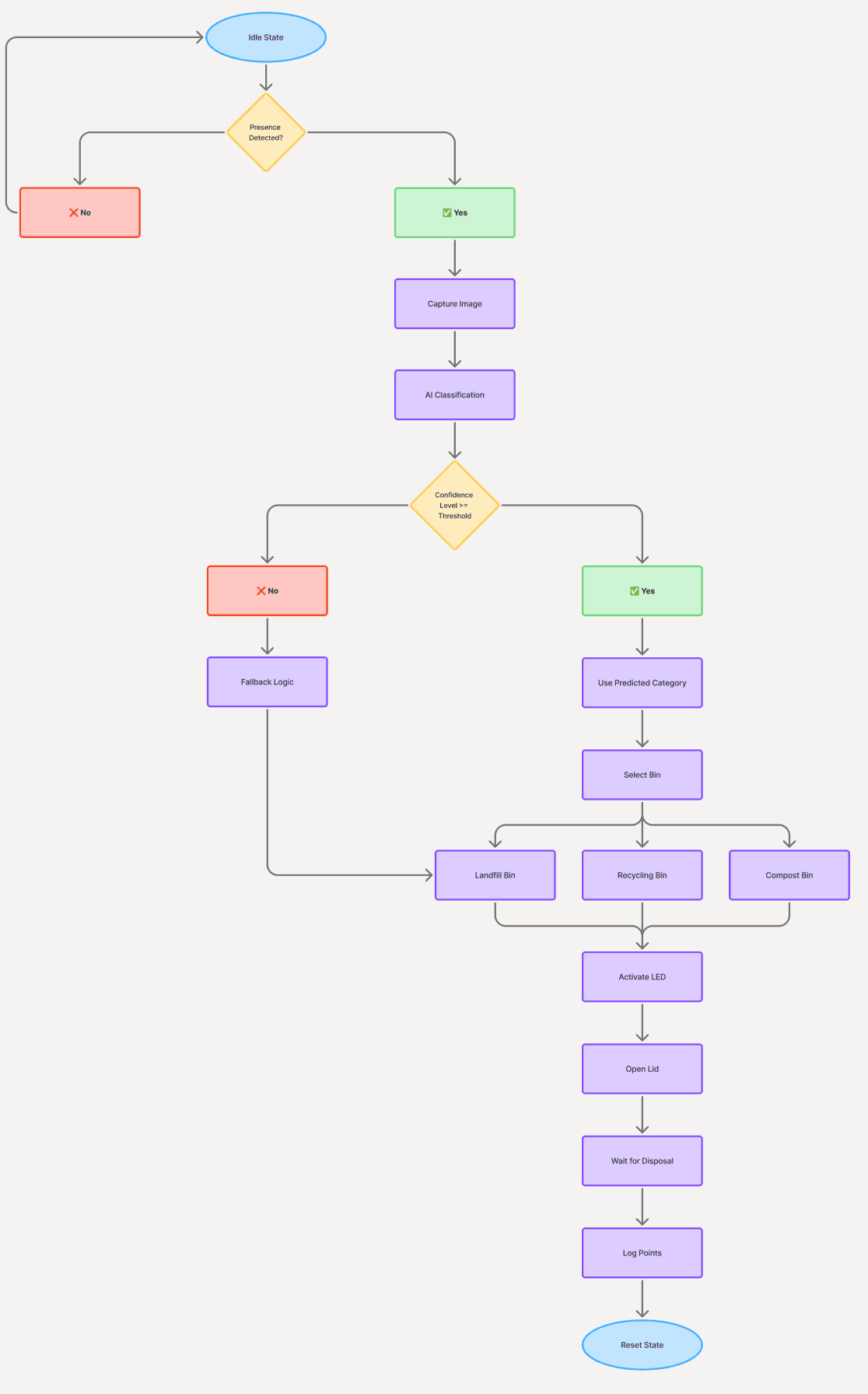
Established the key user flows:
After sketching early concepts, we used our core solution themes and observed behavior of the user to decide which ideas best solved real user problems. These themes helped us refine the sketches into a focused solution and map a clear user flow that showed how the final system should work end-to-end. This flow became the blueprint for our low-fi prototype, defining exactly how users move through the experience and how the system responds at each step.
key user flow
system logic flow
Model Classification Flow
Rewards flow
Established the key user flows:
After sketching early concepts, we used our core solution themes and observed behavior of the user to decide which ideas best solved real user problems. These themes helped us refine the sketches into a focused solution and map a clear user flow that showed how the final system should work end-to-end. This flow became the blueprint for our low-fi prototype, defining exactly how users move through the experience and how the system responds at each step.
key user flow
system logic flow
Model Classification Flow
Rewards flow
Established the key user flows:
After sketching early concepts, we used our core solution themes and observed behavior of the user to decide which ideas best solved real user problems. These themes helped us refine the sketches into a focused solution and map a clear user flow that showed how the final system should work end-to-end. This flow became the blueprint for our low-fi prototype, defining exactly how users move through the experience and how the system responds at each step.
We derived two key User Personas:
Busy College Student
This persona reflects students observed on campus who sort waste quickly under time pressure, often prioritizing speed over accuracy. Ethnographic notes highlighted strong social influence, that is, students sorted better when others were watching. Their primary needs are clarity, low effort, and motivational rewards.
Environmentally Aware Worker
This persona comes from home observations and survey responses showing users who care about sustainability but struggle with inconsistent labels, complex packaging, and systems that rely heavily on visuals. They value accuracy and want reliable, trustworthy guidance, not gamification. Their key needs are consistency, confidence, and clear system feedback.
We derived two key User Personas:
Busy College Student
This persona reflects students observed on campus who sort waste quickly under time pressure, often prioritizing speed over accuracy. Ethnographic notes highlighted strong social influence, that is, students sorted better when others were watching. Their primary needs are clarity, low effort, and motivational rewards.
Environmentally Aware Worker
This persona comes from home observations and survey responses showing users who care about sustainability but struggle with inconsistent labels, complex packaging, and systems that rely heavily on visuals. They value accuracy and want reliable, trustworthy guidance, not gamification. Their key needs are consistency, confidence, and clear system feedback.
We derived two key User Personas:
Busy College Student
This persona reflects students observed on campus who sort waste quickly under time pressure, often prioritizing speed over accuracy. Ethnographic notes highlighted strong social influence, that is, students sorted better when others were watching. Their primary needs are clarity, low effort, and motivational rewards.
Environmentally Aware Worker
This persona comes from home observations and survey responses showing users who care about sustainability but struggle with inconsistent labels, complex packaging, and systems that rely heavily on visuals. They value accuracy and want reliable, trustworthy guidance, not gamification. Their key needs are consistency, confidence, and clear system feedback.
We derived two key User Personas:
Busy College Student
This persona reflects students observed on campus who sort waste quickly under time pressure, often prioritizing speed over accuracy. Ethnographic notes highlighted strong social influence, that is, students sorted better when others were watching. Their primary needs are clarity, low effort, and motivational rewards.
Environmentally Aware Worker
This persona comes from home observations and survey responses showing users who care about sustainability but struggle with inconsistent labels, complex packaging, and systems that rely heavily on visuals. They value accuracy and want reliable, trustworthy guidance, not gamification. Their key needs are consistency, confidence, and clear system feedback.
How might we design waste-sorting solutions that induce behavioral change for accurate and responsible waste disposal by leveraging social pressure and incentives?
SortAble
Smart AI powered
bin system
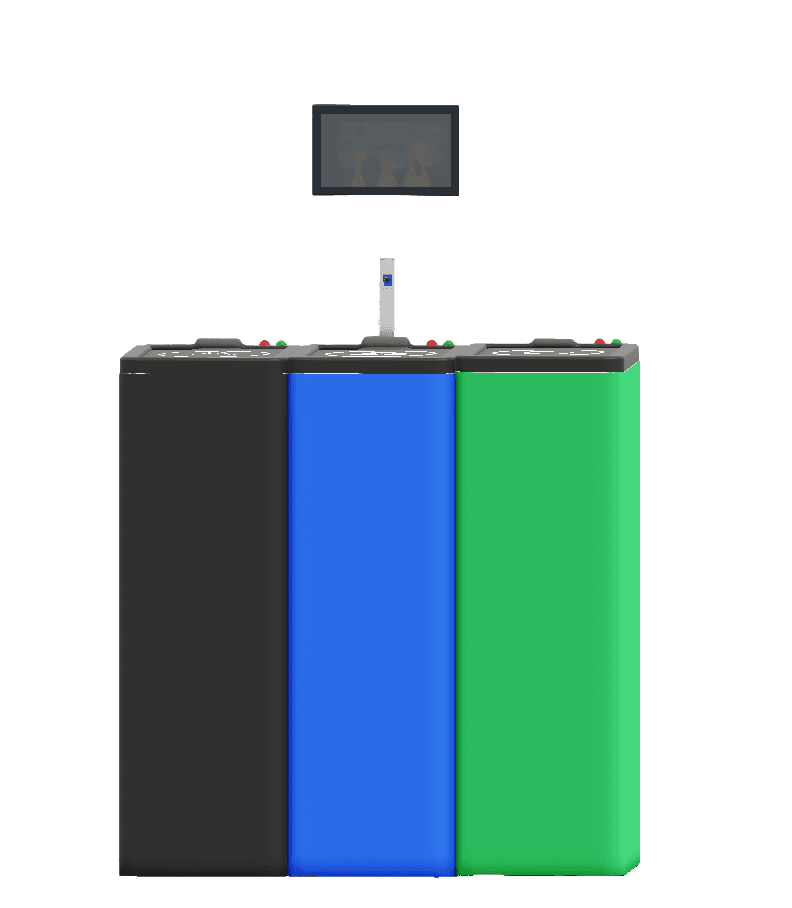
38% of recyclables
rejected due to contamination
We loose nearly over a third of its potentially recoverable waste not because it’s not recyclable, but because it’s SORTED WRONG.
According to data from The Atlanta Journal
THE SOLUTION
An AI-supported waste-sorting system designed to:
Reduce user error
Lower contamination rates
Integrate seamlessly with existing 3-bin infrastructure.
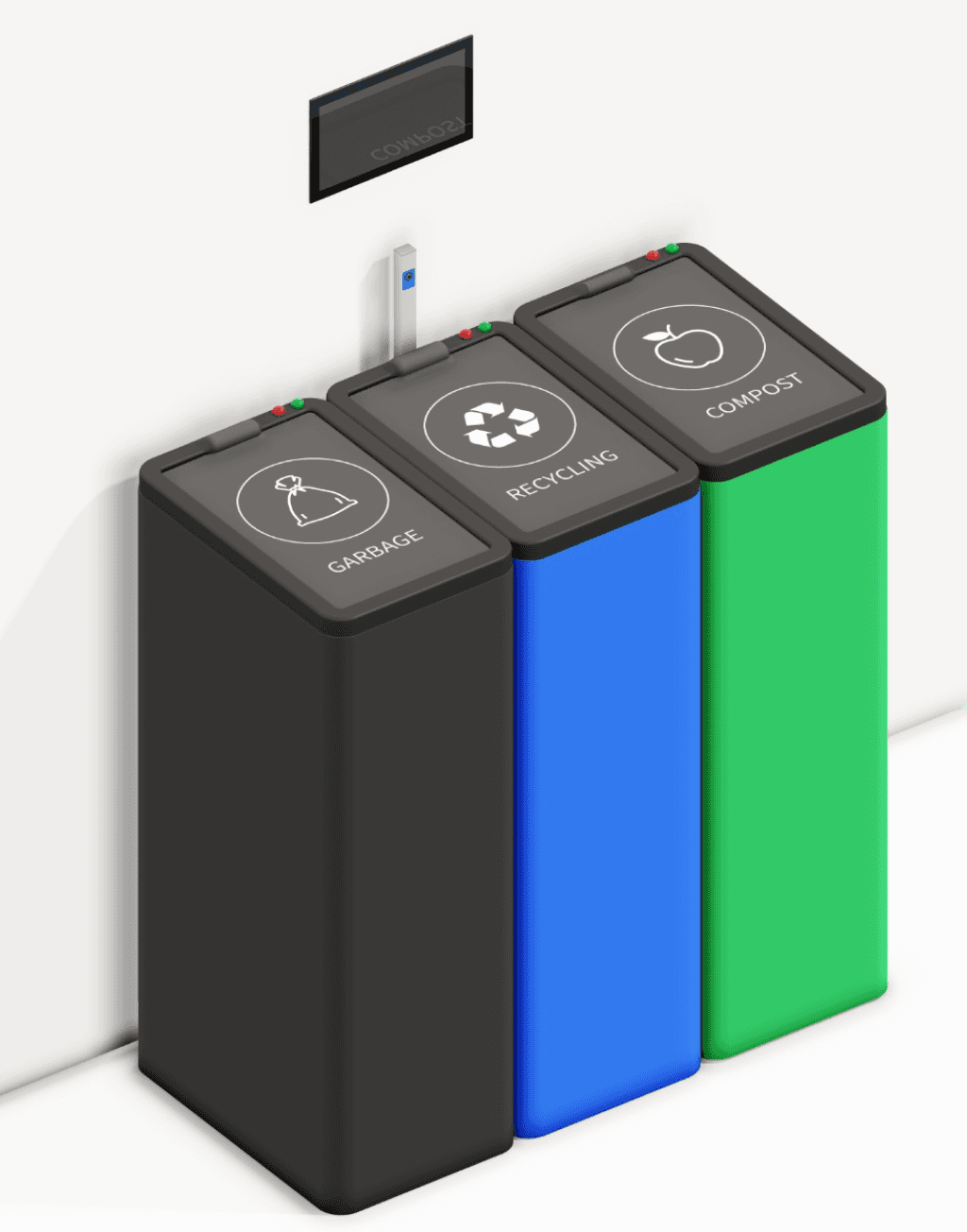
Small Screen Guidance Display
Shows step-by-step guidance
Displays QR code after successful sorting
AI Item Detection Camera
AI identifies item type
Detects recycling vs compost vs landfill
Send bin opening signal
LED Feedback Lights
Green = Bin unlocked and ready
Red = Do not use
Automatic Lid Routing
Opens only when AI approved disposal
Prevents wrong bin usage
Lid closes after item drop
IMPACT
Automated classification reduces human error and contamination.
Improved Sorting Accuracy
Decision time decreases from an average of 3–6 seconds to as little as 1–2 seconds.
Reduced
Cognitive Load
Works with existing 3-bin setups for easy deployment.
Scalable for Public Environments
Rewards and social visibility encourage ongoing use, not just one-time compliance.
Long-Term Adoption
RESEARCH
Surveys (32 Responses)
“What makes it difficult for you to sort waste correctly?”

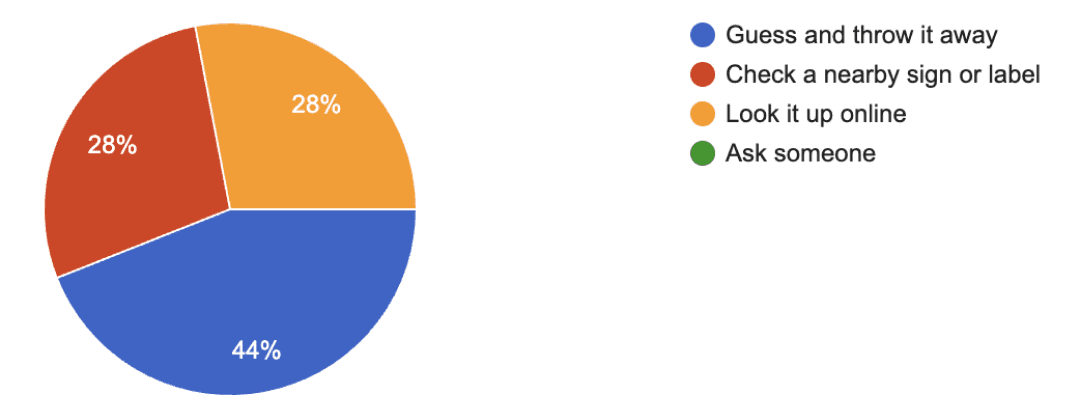
“When unsure where something goes, what do you usually do?”
“How would you dispose of this item”
Contents in compost and container in recycling
Empty the food in the trash and put the plastic in the recycling
Trash bin
Either can be composted or placing in regular bin
All responses reveal users’ confusion &
lack of confidence
while sorting waste.
Observations
Setting: Home environment
Participants: My flatmates (22-25 years of age)
Process: Over four days, I observed how flatmates interacted with kitchen waste bins, noting hesitation, confusion, confidence, and reliance on others when deciding between biodegradable and non-recyclable bins.
Setting: University of Washington
Participants: Students with ages ranging from 18-30 years old
Process: After each lecture, I observed students at the waste-sorting station, tracking how long they took to identify the correct bin, whether labels and images were helpful, and how their behavior changed when others were watching.
While heavy reliance on visual cues was a problem, for eg, when users couldn’t see clearly, they relied on spatial memory, highlighting the need for consistency while designing public waste bins. Users also mentioned that they struggled with complex packaging, which required time and effort to sort and dispose of accurately. They often prioritized speed and efficiency over accuracy.
Experience prototyping and Empathy tools
Competitive Product Survey
KEY INSIGHTS
Lack of consistency leads to sorting errors.

Social Pressure Drives Proper Sorting.
Cognitive load drives users toward convenience.
Smart bins offer promise but lack practicality.
Waste systems rely too heavily on visual cues.
These insights informed four key design requirements for the system:
The design should make proper waste sorting easy to reduce user hesitation at the bin.
Ease & Clarity
The design should motivate users to sort correctly.
Engagement
The system should ensure that users consistently deposit items in the correct bin.
Consistency
The design should make users feel confident approaching any bin, anywhere on campus.
User Confidence
We derived two key User Personas:
This persona reflects students observed on campus who sort waste quickly under time pressure, often prioritizing speed over accuracy. Ethnographic notes highlighted strong social influence, that is, students sorted better when others were watching. Their primary needs are clarity, low effort, and motivational rewards.
Busy College Student
Liam

Age
22
Occupation
Student at UW
Location
Seattle
Personality
Focused on academics
Loves playing basketball
Prefers quick solutions
Bio
Liam is a student at the University of Washington with a packed schedule full of classes and assignments. Despite his busy workload, he loves to make time for play and keeps his days jam-packed from start to finish.
Goals
•
Quickly and confidently dispose of waste without second-guessing.
•
Receive clear guidance to improve sorting accuracy.
•
Minimize frustration when using waste sorting stations.
•
Maintain good habits that contribute positively to the environment without added effort.
Behavior
•
Often running late or pressed for time due to a packed schedule and heavy workload.
•
Frequently multitasking and rushing between classes and assignments.
•
When he’s in a hurry, he tends to make quick, sometimes careless decisions about waste disposal.
•
If the sorting process takes too long or feels complicated, he’s likely to skip proper sorting altogether.
Environmentally Aware Worker
This persona comes from home observations and survey responses showing users who care about sustainability but struggle with inconsistent labels, complex packaging, and systems that rely heavily on visuals. They value accuracy and want reliable, trustworthy guidance, not gamification. Their key needs are consistency, confidence, and clear system feedback.
Kate

Age
27
Occupation
Working Professional
Location
Seattle
Personality
Time conscious
Environmentally aware
Needs clear instructions
Bio
Kate is a Manager at Amazon and commutes via light rail between her apartment in UDistrict to her office. Her job is stressful and her favorite activities are going out to lunch with work friends and eating at local restaurants that specialize in organic foods in South Lake Union.
Goals
•
Wants to feel like her waste sorting is making a difference.
•
Contribute to the environment without adding stress to her daily routine.
•
Feel reassured that she’s made the right choice without needing to ask for help.
Behavior
•
Enjoys meeting up for social events with co-workers after work.
•
Often needs to dispose of items like food scraps, wrappers, and drink containers at transit stations or in shared office spaces.
•
Gets frustrated when bins are inconsistent between locations (station vs. office).
•
Will take an extra moment to sort correctly if guidance is clear and accessible.
With a clear understanding of user and system needs, we generated a series of sketches to explore different solution directions. We then affinity-clustered these sketches to identify patterns, consolidate ideas, and align on the core themes that would guide the final design.
Each sketch was grounded in the core characteristics of our two personas:
Designing for the student’s need for speed, simplicity, and low cognitive load, and for the worker’s need for accuracy, consistency, and clear guidance.
From Requirements to Concept
Established the key user flows:
After sketching early concepts, we used our core solution themes and observed behavior of the user to decide which ideas best solved real user problems. These themes helped us refine the sketches into a focused solution and map a clear user flow that showed how the final system should work end-to-end. This flow became the blueprint for our low-fi prototype, defining exactly how users move through the experience and how the system responds at each step.
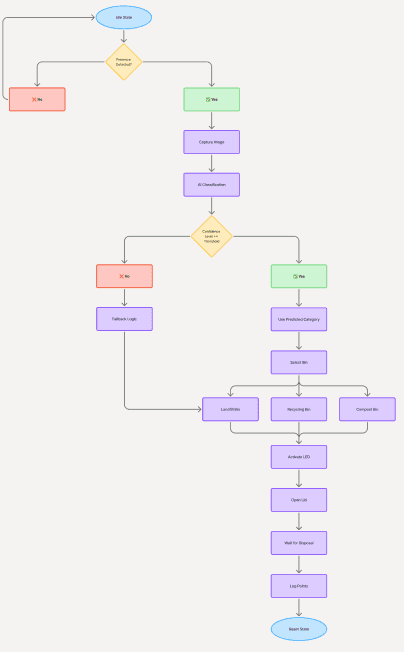


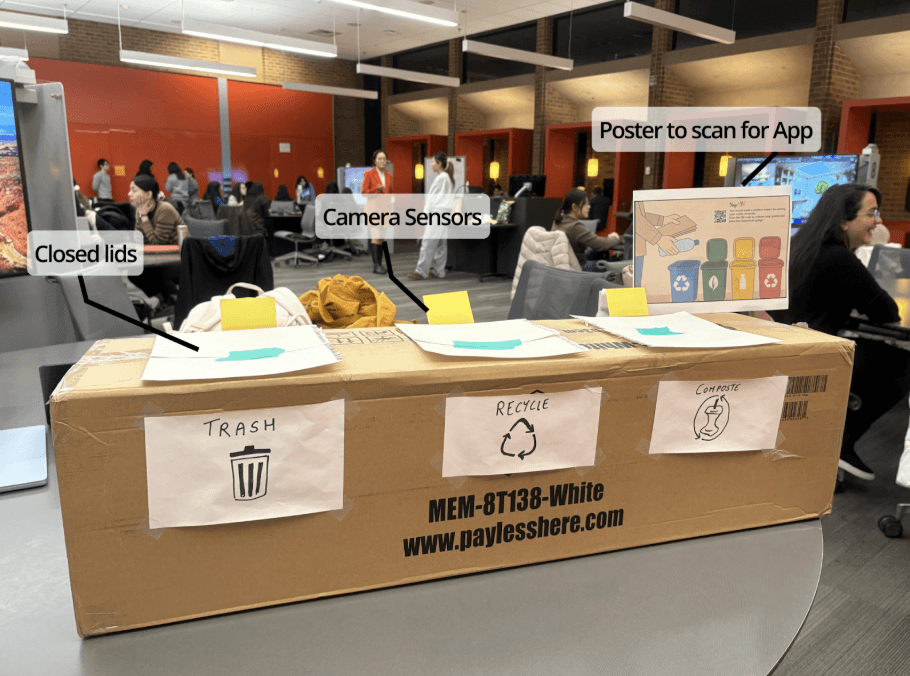
ConductED Usability Testing on the Lo-Fi Prototype
With the solution user flow defined, we tested early prototypes to validate whether the interactions truly supported our core themes of clarity, engagement, consistency, and confidence.
Key elements:
Three compartments (Recycle / Compost / Trash)
Paper lids for Wizard-of-Oz automated lid simulation
Open-lid sections for comparison testing
Sticky-note “camera sensors”
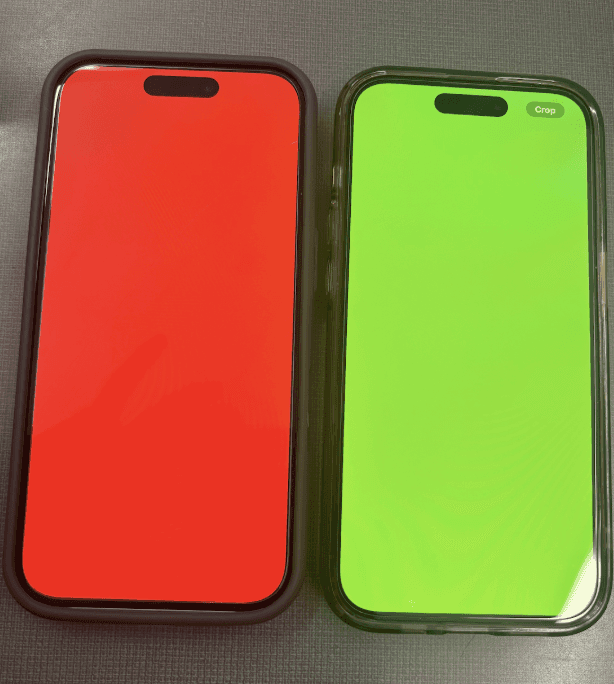
Phone-based red/green light feedback (correct/incorrect bin)
What it tested:
Spatial layout, user hesitation, scanning visibility, and lid interaction behavior.
🗑️ Physical Bin Prototype
Key elements:
QR code scan confirmation
Points dashboard
Rewards & redemption clarity
Leaderboard with peer motivation
Seamless app integration (Sustainability section)
What it tested:
Understanding of point value, clarity of redemption flow, and motivation through gamification.
📱 Mid-Fi App Prototype
Key
Observations
Design
Iterations
Closed bins encouraged more intentional sorting.
Shifted to closed-bin design.
Open bins led users to ignore the scanner.
Removed open bins entirely.
Multiple cameras created confusion.
Consolidated cameras into one central scanner.
QR code for rewards was missed by most users.
Added a central instructional screen.
Users didn’t understand the value of their points.
Redesigned Sustainability section in MyUW app.
FINAL SOLUTION
Present Item to Camera
The system automatically identifies the item, eliminating user guesswork and reducing decision friction.
Correct Bin Opens Automatically
By routing items to the correct bin, it significantly decreases mis-sorting and contamination.
Drop Item Into Opened Bin
Reinforces proper sorting patterns.
Scan QR & Earn Points in UW App
Motivates continued sorting by connecting actions to rewards. Leaderboard visibility provides social validation and encourages responsible sorting through gentle social pressure.
KEY SYSTEM COMPONENTS
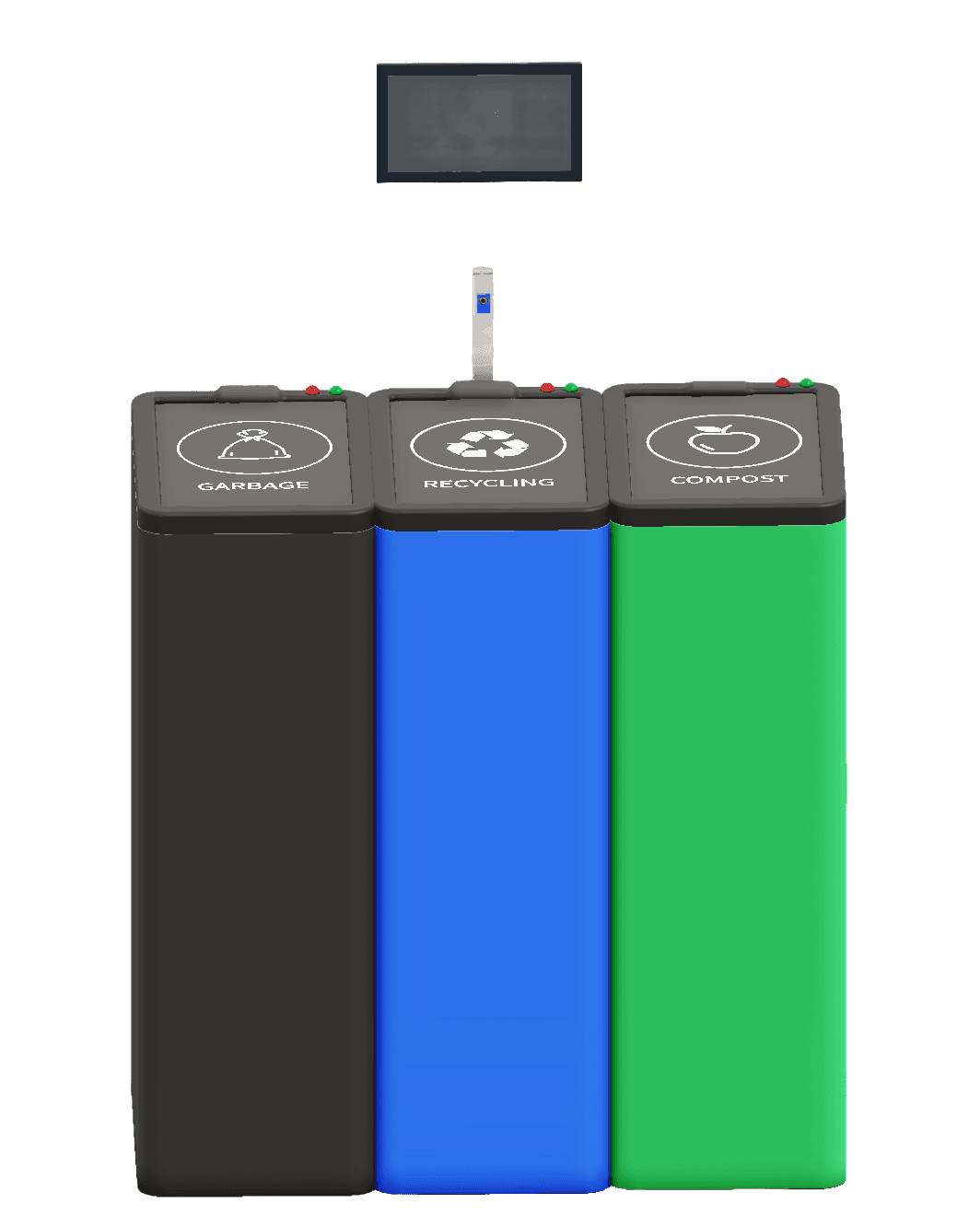
AI Item-Detection Camera
Identifies the item held in front of the lens and classifies it into compost, recycling, or landfill using a campus-trained detection model.
Automatic Bin Routing
Once classified, the correct bin opens automatically via a servo-controlled lid, reducing user effort and eliminating guesswork.
LED Feedback Indicators
Green confirms correct routing; red appears when classification confidence is low. Low-confidence items default to landfill to protect against cross-stream contamination.
Incentive Integration
(MyUW App)
After disposing, users may scan the QR code to earn sustainability points. Points can be redeemed via their Husky Card, and users can view progress on a leaderboard, encouraging socially reinforced participation.
On-Bin Display Interface
Provides quick visual guidance and generates a scannable QR code for user rewards.
LIMITATIONS
While the SortAble concept is feasible, several constraints must be acknowledged:
Implementation Cost:
Building a fully functional smart bin, equipped with sensors, a display screen, and onboard AI hardware, would require an upfront investment. For comparison, existing commercial smart-waste units from competitors such as Bigbelly retail in the ~$1.6k–$4.8k range (Bigbelly Products).
However, long-term cost savings can offset this investment. Seattle Public Utilities (SPU) currently charges $234.80 per ton for commercial garbage disposal, and the city generates approximately 1,300 tons of waste per day. Even modest reductions in landfill-bound waste or contamination can translate into meaningful financial savings at this scale. By improving sorting accuracy and increasing diversion, a smart-bin system has the potential to reduce ongoing disposal costs and provide net savings over time. (Seattle Public Utilities)
Electrical Infrastructure:
Public bins across campus would require access to reliable power sources, which may not be available in all locations.
UW Point System Constraints:
Integrating SortAble with the Husky Card rewards system involves monetary value and would require administrative approval, policy adjustments, and system integration work.
Concurrent Users:
The current design supports one user at a time. Multiple users approaching the system simultaneously could cause confusion or slow down the interaction.
Spending time on SortAble showed me how small design choices can create real confusion in everyday tasks. Turning moments of hesitation and frustration into sketches, flows, and prototypes was challenging but incredibly rewarding. This experience taught me how to design solutions that truly support sustainable habits.
REFLECTION